Buyer's Guide · 2026 Edition · Factory-Direct

Best Wall Printer for Your Business in 2026: The Complete Buyer's Guide

5 machine types compared by use case — mobile decorator, print shop, mural contractor, wallpaper studio. Each business model has a different winner. Factory-direct from WallPrintBox since 2018.

Factory-direct · Since 2018 · 47 countries · 5-year spare parts guarantee

Framing the question

What "Best" Actually Means in Wall Printing

Three operators asked the same question — three different machines won. The right machine depends on how you work, not on the highest DPI spec sheet.

Mobile Operator

Solo or 2-person team. Setup from a van in under 20 minutes. Jobs are residences, cafés and pop-ups — rarely above 20 m² per wall. Throughput speed is irrelevant; portability and fast setup are everything.

Needs: machine under 45 kg that breaks down to fit a standard van. Surface: smooth interior only.

Winner: Vertical Wall Printer
Commercial Print Shop

Fixed premises, existing RIP workflow and colour SLAs. Clients are brand managers — Delta-E colour accuracy is contractual. Repeat orders of 6–50 m² brand walls are standard work.

Needs: 2880 DPI, Delta-E <2, and ink system that integrates with current RIP colour management.

Winner: Inkjet Wall Printer

Large-Format Mural Contractor

Projects are exterior walls, public art and hotel lobbies — typically 15–80 m² per job. UV-rated ink is mandatory for outdoor durability. Throughput matters: 15–25 m²/h means the difference between one day and three days on site.

Needs: 4 m+ width, UV-rated ink, and a machine that can handle exterior substrates.

Winner: Mural Printer

5 Machine Types

The 5 Wall Printer Types: At a Glance

One-minute briefing on each type. Full technical specs, pricing and configuration options are on each product page.

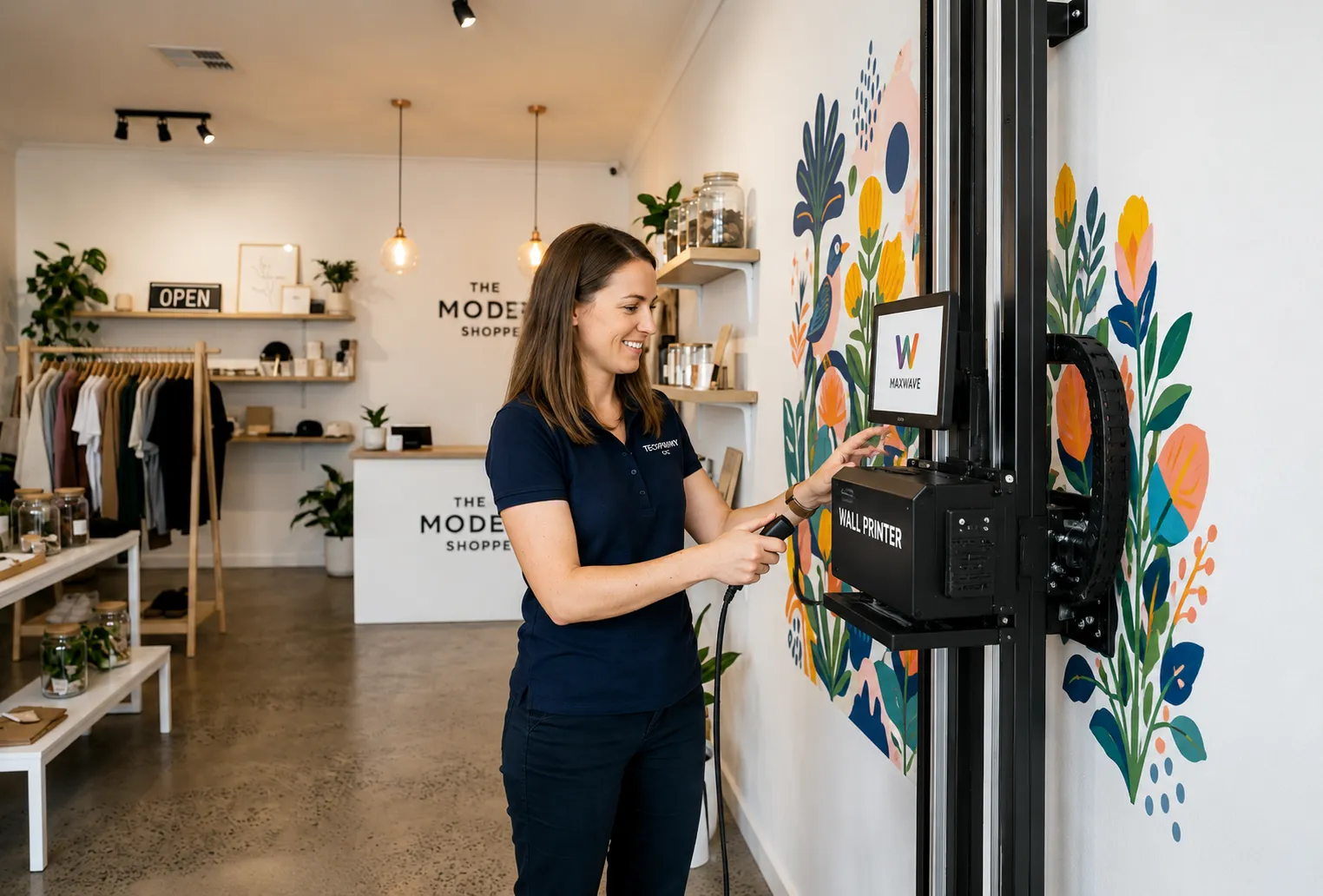
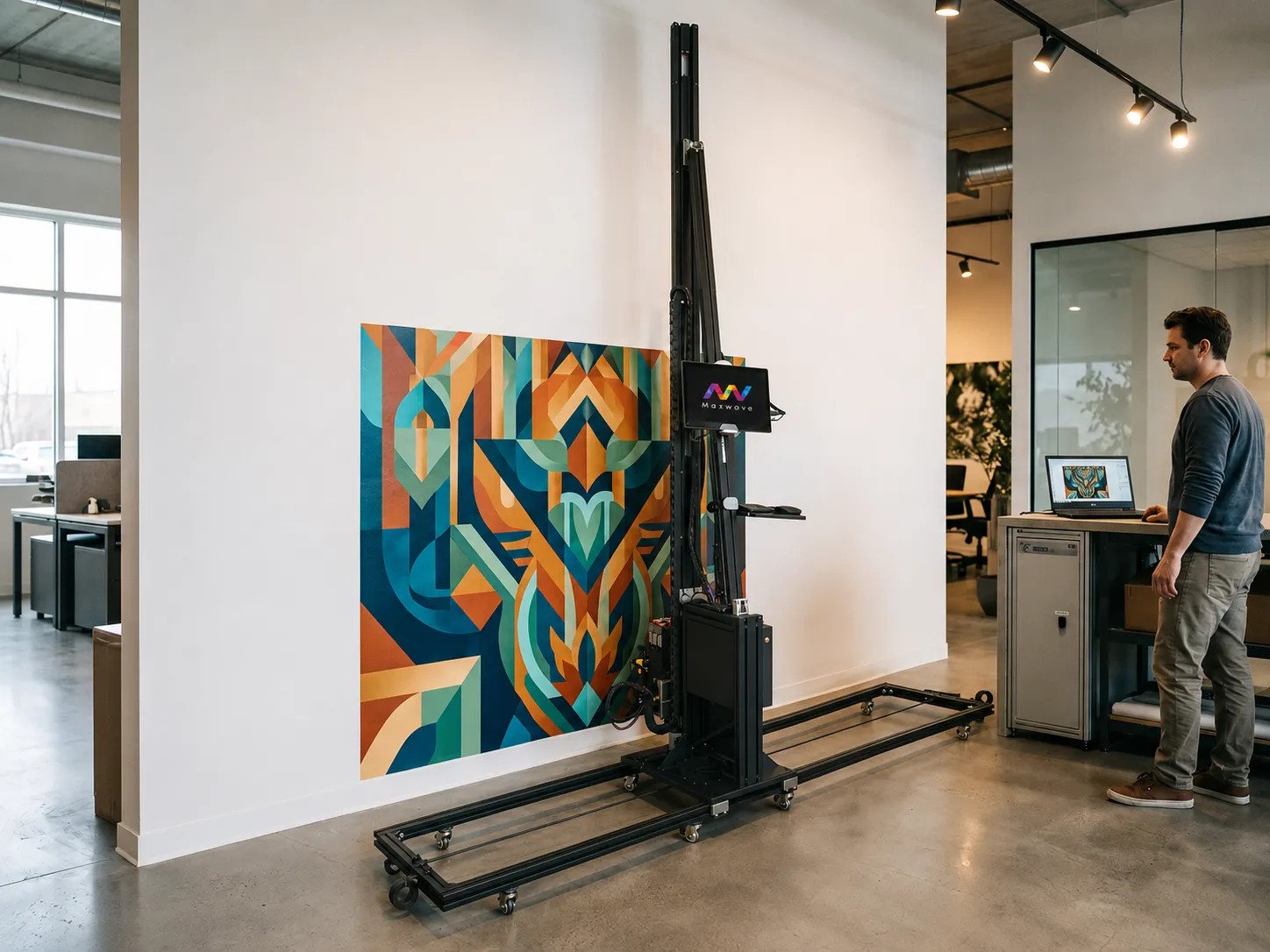
Vertical wall printer in operation printing on an interior wall

Vertical Wall Printer

3.2 m height · 8–12 m²/h · ~45 kg

Portable single-carriage printer for smooth interior walls. Sets up in 15 minutes. The mobile decorator's default choice.

Full specs
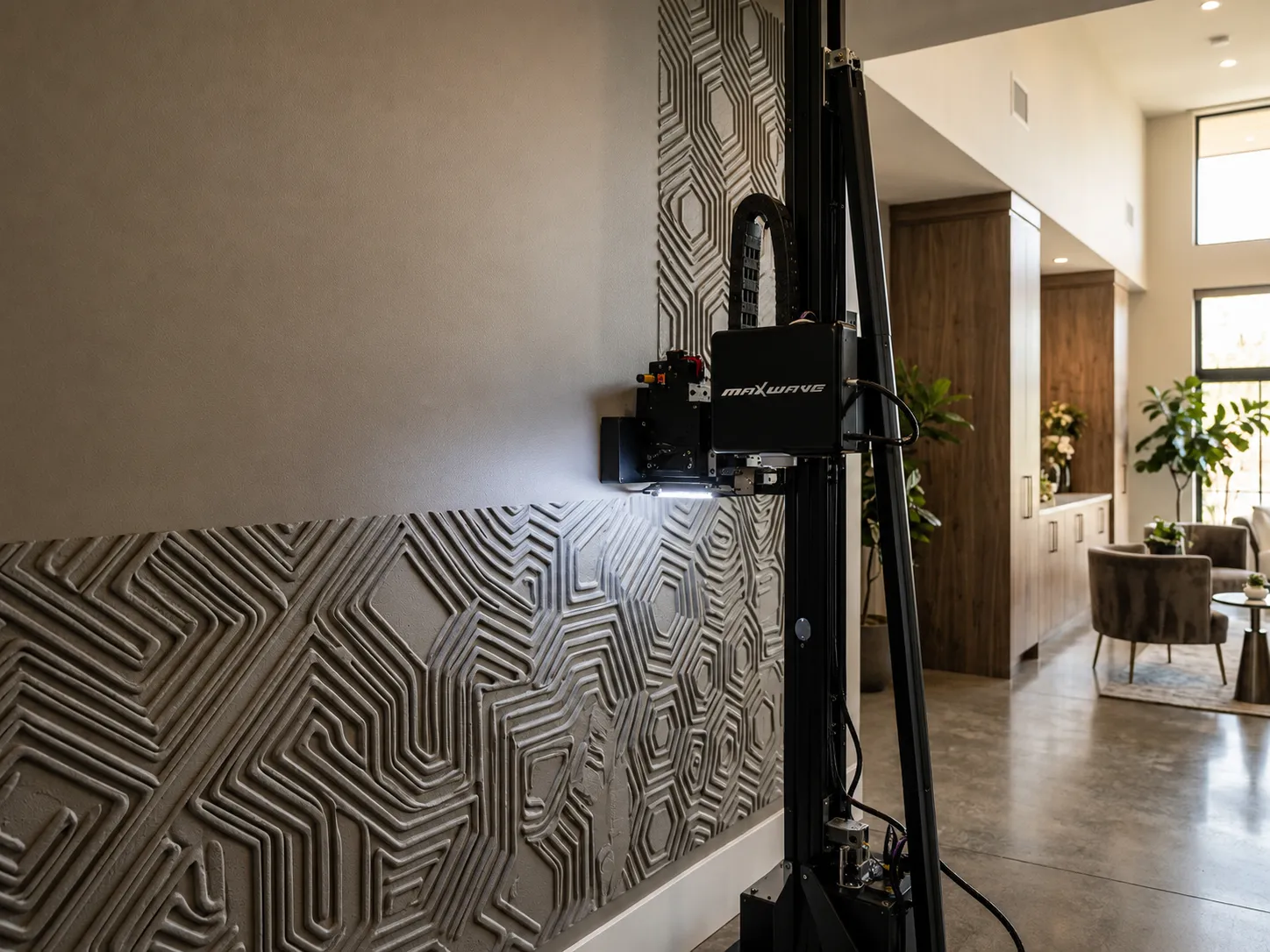
3D wall printer producing textured relief surface on interior wall

3D Wall Printer

0.5–3 mm depth · 2–4 m²/h · ~65 kg

Tactile relief output for high-end interiors. Slower throughput — premium per-m² pricing justifies the rate.

Full specs
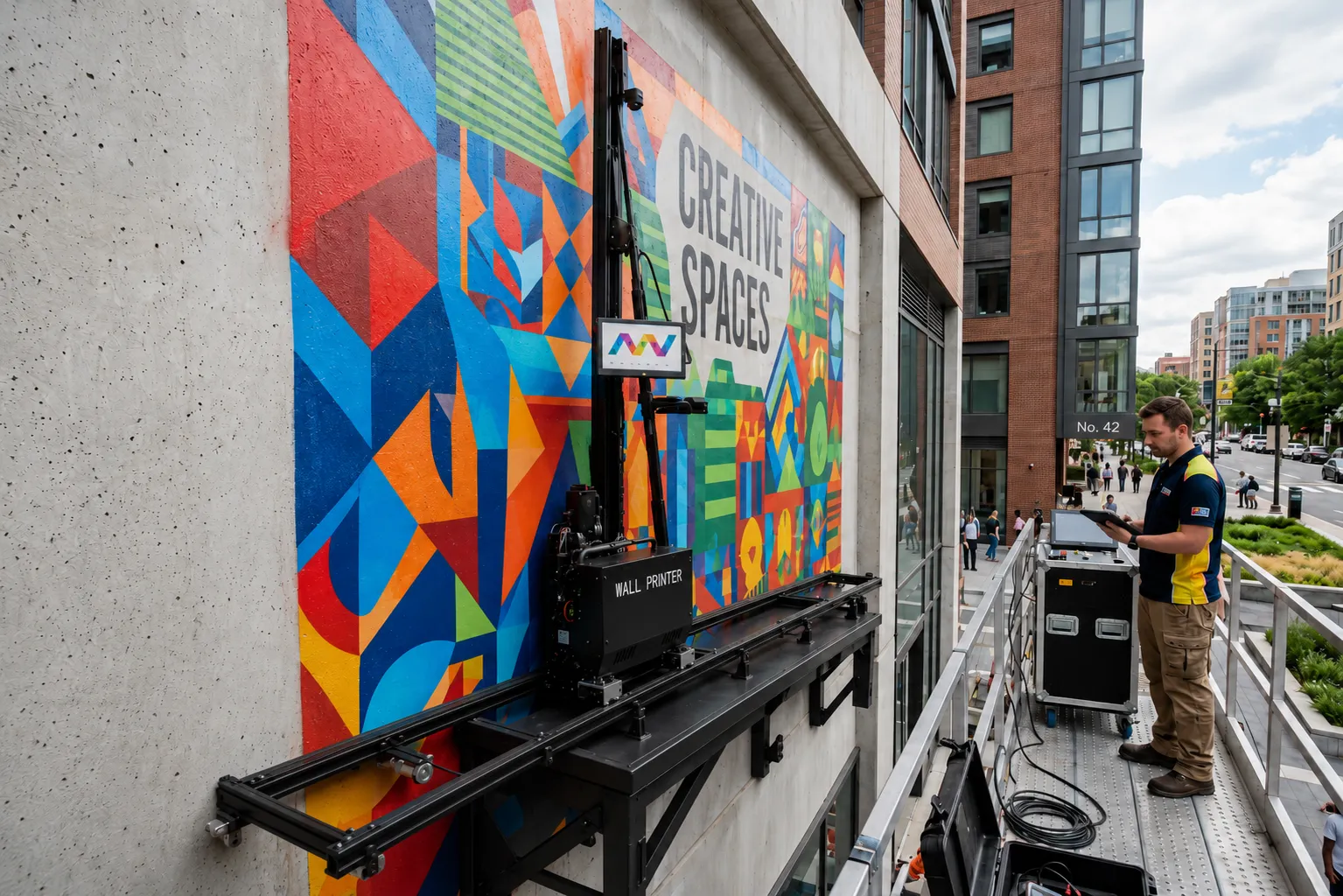
Mural printer printing a large outdoor mural on exterior building wall

Mural Printer

4 m width · 15–25 m²/h · ~60 kg

High-throughput semi-fixed printer with UV-rated ink for exterior walls. The contractor's production machine.

Full specs
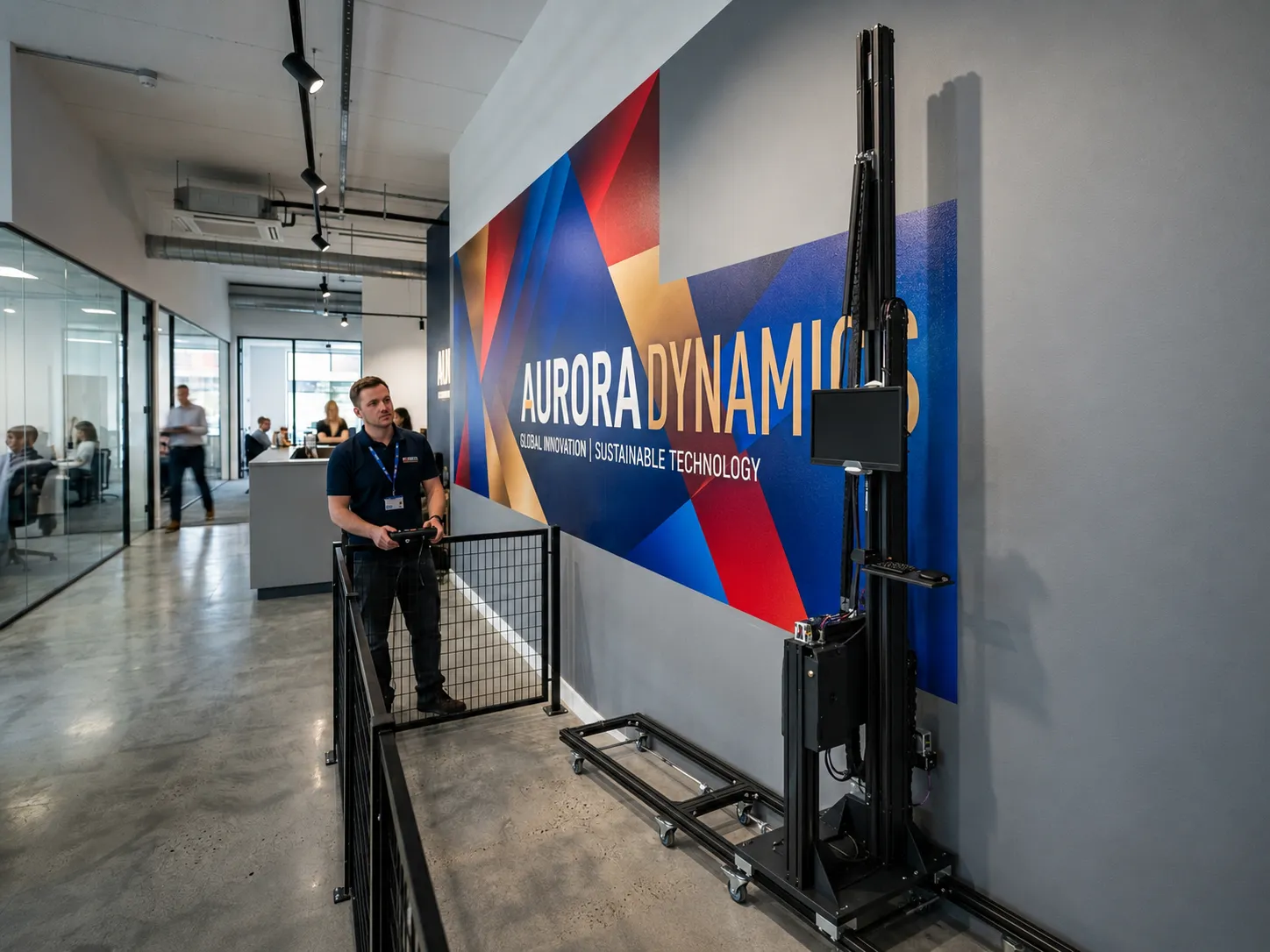
Inkjet wall printer producing precise colour-accurate brand wall in commercial space

Inkjet Wall Printer

1440 DPI · Delta-E <2 · 6–10 m²/h · ~75 kg

Colour-critical output for brand managers and print shops. Integrates with RIP workflows for consistent results.

Full specs
Wallpaper printer feeding substrate roll for custom wallpaper production

Wallpaper Printer

1.5–2.0 m roll · 20–40 m²/h · ~55 kg

Substrate-feed system for custom wallpaper production. High throughput for studios serving interior design trade.

Full specs

Decision Framework

Buying Criteria Matrix: 5 Types Side by Side

Six decision criteria scored across every machine type. Horizontal scroll on mobile. Sticky row labels on the left.

Criterion Vertical
Wall Printer
3D
Wall Printer
Mural
Printer
Inkjet
Wall Printer
Wallpaper
Printer
Max DPI 720–2880 360–720 720–1440 1440 720–1440
Speed (m²/h) 8–12 2–4 15–25 6–10 20–40
Portability High (~45 kg, folds) Medium (~65 kg) Low (~60 kg) High (~75 kg) Low (~55 kg, fixed)
Surface types Smooth interior Textured interior Smooth ext + int Smooth interior Substrate / roll
Deployed footprint 0.6 × 0.8 m 0.8 × 1.0 m 1.2 × 1.5 m 0.6 × 0.9 m 1.0 × 2.0 m
Operating cost/m² $0.18–0.28 $0.35–0.55 $0.22–0.34 $0.24–0.38 $0.12–0.20
5 Machine types compared
6 Buying criteria scored
1 Machine matched to your business

Business Model Match

Which Machine Fits Your Business Model?

Match your operation type to the right machine before you spec a single part number.

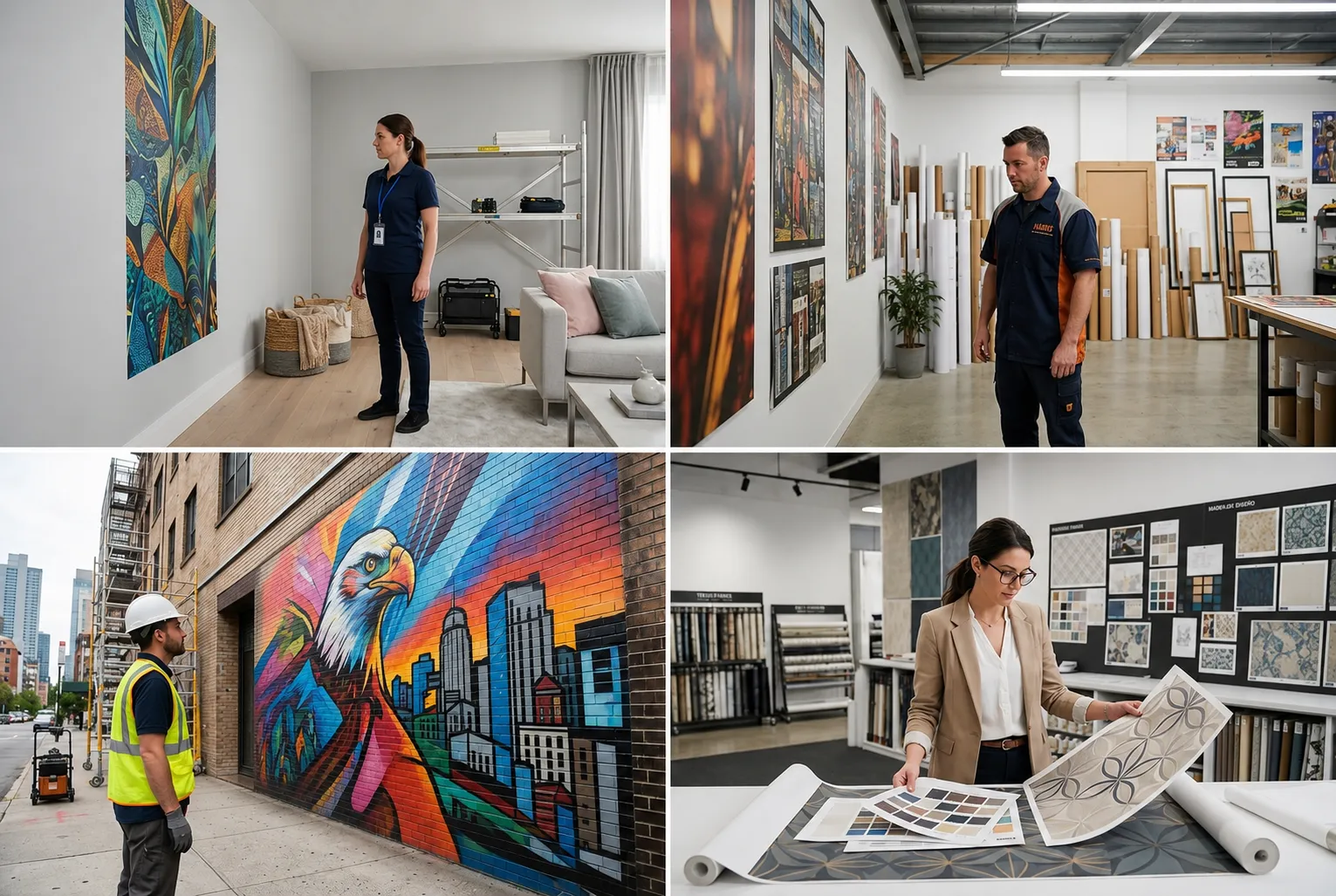
Four different wall printing business operators — mobile decorator, print shop, mural contractor and wallpaper studio

Mobile Decorator

  • Solo or 2-person team, van-portable setup
  • Jobs: residences, cafés, retail pop-ups
  • Typical revenue: $200–600 per wall
  • Priority: setup speed, machine weight, foldability

45 kg · folds in 15 min · 3.2 m height clearance · 8–12 m²/h

Commercial Print Shop

  • Fixed premises, existing RIP press workflow
  • Jobs: brand walls, retail, hospitality contracts
  • Delta-E colour accuracy is a contractual SLA
  • Priority: 2880 DPI precision, RIP integration

1440 DPI · Delta-E <2 · 6–10 m²/h · 65 kg

Mural Contractor

  • 2–4 person crew, exterior and public art projects
  • Jobs: hotels, stadiums, murals >30 m²
  • UV-rated ink mandatory for outdoor durability
  • Priority: throughput, UV ink, 4 m+ width

4 m width · 15–25 m²/h · UV-rated · ~75 kg

Wallpaper Studio

  • Interior design trade and custom residential
  • Jobs: bespoke wallpaper panels, rolls, repeat patterns
  • Roll substrate workflow, high-volume production
  • Priority: substrate feed, throughput, roll width

1.5–2.0 m roll · 20–40 m²/h · substrate feed · ~55 kg

Common Errors

5 Mistakes Buyers Make When Choosing a Wall Printer

These errors cost buyers money in the first 90 days. Know them before you sign.

Business owner reviewing wall printer specifications and cost calculations at a desk
01

Budget-Anchoring on Price

Choosing the cheapest machine ignores operating cost per m². A $6,000 machine at $0.55/m² costs more over 18 months than a $12,000 machine at $0.22/m² at any meaningful volume. Calculate total cost of ownership — not sticker price.

02

Ignoring Surface Type

A machine rated for smooth interior walls will fail on render, brick aggregate or exterior substrates. Verify the surface compatibility matrix against every substrate your clients will actually request before quoting any job.

03

Underestimating Consumable Cost

Ink is not a one-time expense — it's your margin. Demand the supplier's documented cost-per-m² figure for the ink set at standard resolution. If they won't publish it in writing, that figure is hiding something. Walk away.

04

Skipping Support Evaluation

A 4-hour first response SLA means a same-day resolution on most electrical faults. A 72-hour response on a 2-person operation means 3 days of zero revenue on a live job site. Ask specifically how the supplier handles after-hours emergency calls before you order.

05

Buying Industrial When Portable Fits

If your jobs are under 25 m² and under 3.2 m height, a 130 kg semi-fixed machine adds setup time, transit cost and footprint complexity with zero throughput benefit. Scale up when your volume justifies it — not before.

Due Diligence Checklist

5 Questions to Ask Before You Commit

Three spec questions and two support questions. The supplier's answers tell you everything about whether they'll still be responsive 18 months after delivery.

Spec Questions

"What is your documented ink consumption per m² at production resolution (2880 dpi)?"

Forces the supplier to state real operating cost in writing. Vague answers indicate the number is worse than the headline spec. WallPrintBox publishes this by machine type — ask us.

"What surface preparation does this machine require before printing?"

Reveals hidden prep cost and surface limits. Some machines require sanding, primer coats or specific moisture levels — this affects your job scheduling and client quotes.

"What is the operating temperature and humidity range for reliable output?"

Reveals whether the machine works in your climate year-round without special air conditioning. Critical for tropical, desert and cold-winter markets.

Support Questions

"What is your first-response SLA for a technical fault during a live job?"

Industry average: 24–72 hours. WallPrintBox answer: 4 hours, confirmed in the service agreement. A live job means a client on-site — a slow response means you absorb the cost of delay.

"In which languages can your support team respond, and during which hours?"

A support team that only operates in Mandarin during Beijing business hours is effectively unavailable for most of the world. WallPrintBox support: EN/ES/AR/PT/FR across three time zones.

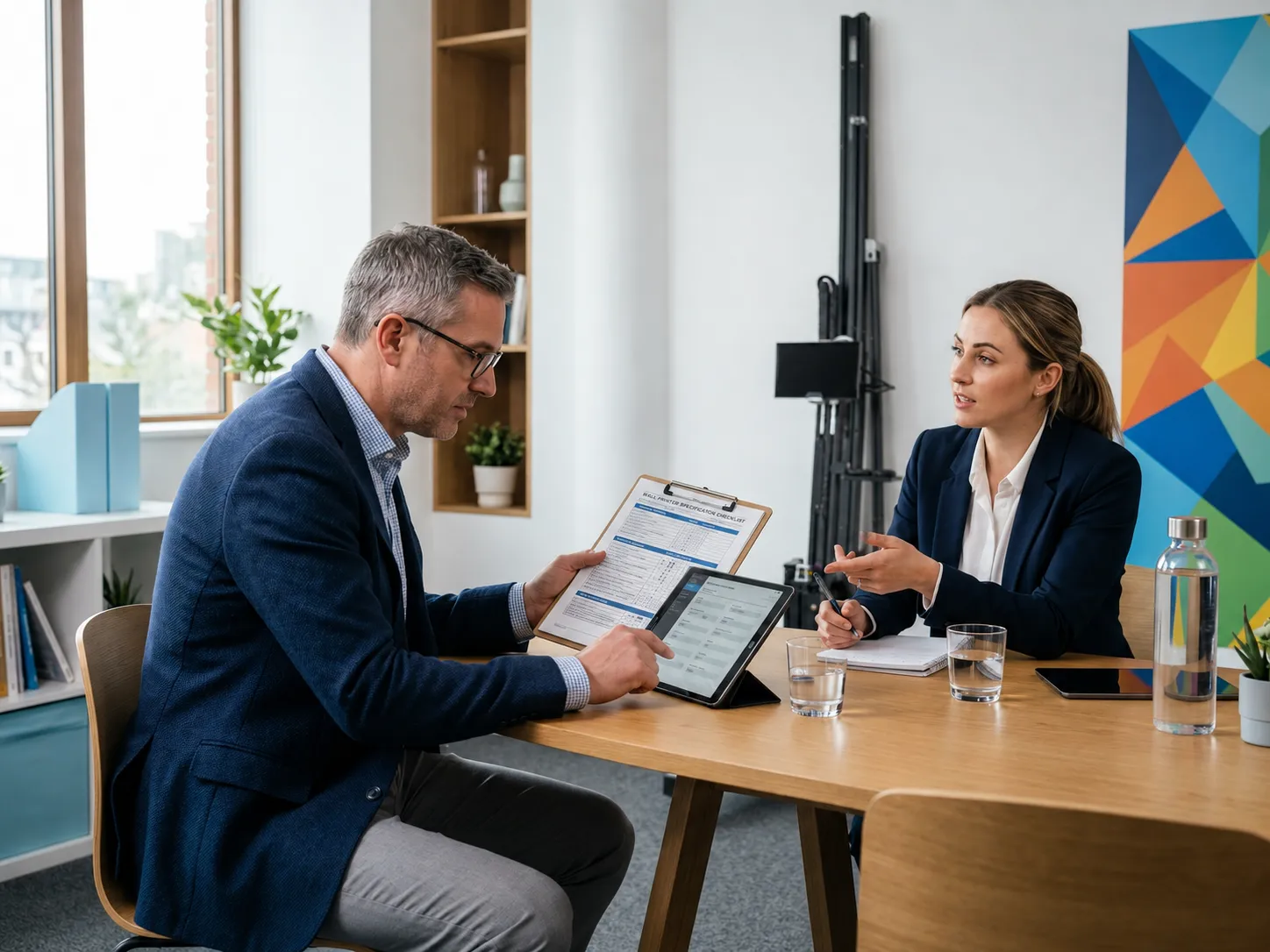
Business buyer reviewing technical specification checklist with wall printer supplier

Tell Us Your Business Model — We'll Spec the Right Machine in 24 Hours

Factory-direct from WallPrintBox. OEM MOQ 5 units. 5-year spare parts guarantee. 4-hour first response SLA across 5 support languages.

Request a Spec Match
Factory-direct Since 2018 47 countries 5 support languages 4-hr first response

Common Questions

Frequently Asked Questions

Buyers in 47 countries asked these. Here are the direct answers.

No. Each type is optimised for a different workflow. The Mural Printer wins on throughput for large exterior jobs; the Inkjet Wall Printer wins on colour accuracy for brand-critical commercial work; the Vertical Wall Printer wins on portability for mobile operators. Choosing without matching type to workflow is the most common — and most expensive — buying mistake.

No — each type uses different ink systems, surface-clearance mechanisms and carriage designs. Switching means buying a new machine. That's why matching to your business model before purchase matters more than finding a price deal on the wrong type.

Single-unit orders ship. OEM MOQ is 5 units for logo, colour and software customisation. Reseller pricing starts at 3 units. Contact us for a current quote with your destination port.

Sea freight: 18–35 days from factory to port depending on destination. Air freight available at additional cost. Every crate includes the machine, full ink set, spare printhead, software licence, printed quick-start guide, and access to the online training portal. No hidden unpacking fees.

Ready to Match Machine to Business?