Wall Printer vs Hand Painting: The Commercial Decision Guide
Speed, cost, consistency and scale — everything interior contractors, developers and project managers need before committing to either method on a commercial rollout.
Method Overview
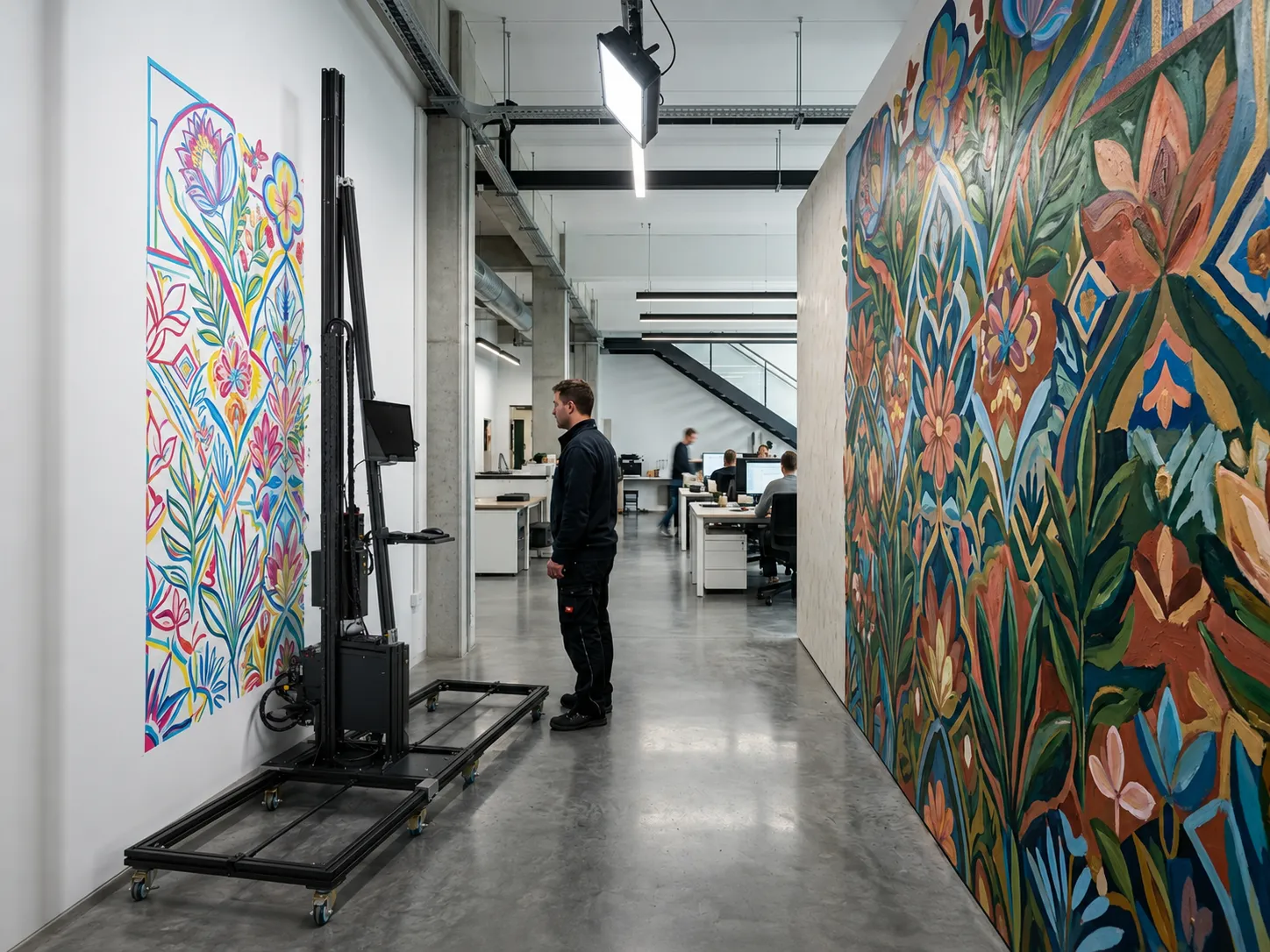
Two Methods, Two Workflows
Before the numbers, understand what you are actually buying — a person's time or a machine's time.
Muralist Workflow
- 1 Brief & site survey (2–4 hours on-site)
- 2 Sketch approval round (1–3 days back-and-forth)
- 3 Wall prep: filler, primer, basecoat (half day)
- 4 Hand painting at 1–2 ㎡/h (skilled artist only)
- 5 Touch-up & varnish finish (half day)
- 6 Unique original — no digital copy. Repeat = full commission
Wall Printer Workflow
- 1 File prep: confirm artwork at 100 dpi minimum (5 minutes)
- 2 Wall prep: clean, dry surface check (15 minutes)
- 3 Machine setup: level and calibrate (10 minutes)
- 4 Print at 8–25 ㎡/h depending on machine model
- 5 Optional topcoat application (15 minutes)
- 6 File stored — every repeat is pixel-identical at ink cost only
Head-to-Head Data
The Numbers Side by Side
Eight metrics that matter for commercial project planning — not showroom specs, real-world commercial figures from contractors running both methods.
| Metric | Hand Painting | Wall Printer |
|---|---|---|
| Production speed | 1–2 ㎡/h (skilled muralist) | 8–25 ㎡/h (machine-dependent) |
| Consistency across sites | One-off original — no exact repeat possible | Pixel-identical from same digital file |
| Setup time per job | 3–7 hours (survey + sketch approval) | 35–50 min (file check + machine level) |
| Minimum viable job size | Any — artist is paid by day or ㎡ | ~4 ㎡ (below this, setup time dominates) |
| Surface compatibility | Plaster, brick, canvas, outdoor — highly flexible | Smooth/textured interior walls, ceiling, floor |
| Skill required on-site | Trained artist (specialist hire, scarce) | Trained operator — 1-day certification |
| Revision / update cost | Full repaint = near-full commission cost | Reprint: ink + operator time only |
| Daily production capacity | 8–16 ㎡ per operator per day maximum | 60–200 ㎡ per machine per day |
8–25× Faster · Reproducible from Any File · No Artistic Skill Required
Cost Analysis
What a Typical 50 ㎡ Commercial Mural Actually Costs
A concrete side-by-side for the same job: a 50 ㎡ feature wall in a corporate reception or hotel corridor. All figures in GBP at current UK market rates.
Hand Painting — 50 ㎡
- Artist day rate (3–4 days) $2,000–6,000
- Wall prep materials (primer, filler, basecoat) $100–300
- Scaffold / access equipment if required $200–8000
- Varnish / protective topcoat $100–300
- Travel + accommodation (regional) $200–1,000
Per ㎡: $52–168
Wall Printer — 50 ㎡
- Ink cost ($0.4/m² × 50 m²) $20
- Machine amortisation $50–150
- Operator time (2–3 hrs) $50–150
- Wall prep (clean + dry surface check) $20–50
- Travel (same day, local operator) $20–50
Per ㎡: $3–8 / m²
Honest Assessment
No Tool Wins Every Job — Here Is the Honest Split
Wall printers dominate commercial volume. Hand painting still wins a specific tier — and pretending otherwise loses credibility with experienced fit-out buyers.
Hand Painting Still Wins
- Ultra-high-end residential commissions ($650+/㎡ budgets) where artist identity is the value
- Artist-signature murals — the creator's name is the commercial proposition
- Organic or tactile surfaces: raw clay, heritage brick, irregular stone — not printable
- Fine art installations requiring colour-mixing depth beyond UV/water-based ink capability
- Commissions where exclusivity and uniqueness is explicitly part of the client brief
Wall Printer Wins
- Commercial rollouts across 3+ sites requiring identical, reproducible artwork
- Brand consistency mandates: retail chains, franchise networks, co-working spaces
- Tight timelines: 2 working days or less per site
- Seasonal refresh cycles: campaign rotations every 3–6 months
- Budget under $45–55/㎡ all-in — only path viable at this price point
Decision Framework
3 Questions Before You Commit Either Budget
Answer these in order. Your answer to Q1 determines whether the rest of the analysis even matters for your specific project.
Question 1 of 3
Do you need the same output reproduced across more than one site?
Question 2 of 3
Does the project timeline allow more than 5 working days per site?
Question 3 of 3
Is your client's effective budget under $50/㎡ all-in for the mural work?
Ready to Replace the Estimate with a Spec?
Request a quote in 24 hours — we respond with machine specs, ink cost per ㎡, and a production rate for your exact project size.
Common Questions
Common Questions When Comparing Methods
From contractors and project managers evaluating both options for the first time.
Ready to compare machine specs for your next commercial brief?
See Full Machine Specs