By your third supplier Zoom call and fifth unanswered quote request, one thing becomes clear: the wall printer industry has a serious transparency problem. Dealer pricing exists — but vendors guard it like classified information. Profit margins are real — but nobody publishes the actual numbers. That changes here.
This guide breaks down the most relevant wall printer vendors with dealer pricing. It compares reseller programs side by side. You also get a scoring framework you can apply to any vendor — including the ones cold-emailing you right now.
We cover FOB factory prices, regional exclusivity clauses, and the fine print that cuts into your margins. We did the vetting. Your shortlist now takes hours, not months.
The Wall Printer
North America has a wall printing vendor that doesn't just sell you a machine — it sells you a business model with a manual included.
The Wall Printer (TWP) is headquartered in North America. Its entire positioning centers on one core promise: turnkey support from day one. So where does TWP sit in the market for direct to wall printing equipment? Above the $5k–$15k Chinese commodity machines. Well below the $45k–$60k German Wallpen E2. Right in the mid-premium tier where local training and service justify the price.
Retail price range: $25,000–$35,000+ per unit. The flagship line is the T Series Wall Printer and FUV Floor Printer.
Dealer Economics: What the Numbers Look Like
Territory partners get distributor discounts of 15–30% off MSRP. At a retail price of $29,995–$34,995, that breaks down to:
Indicative dealer buy price: ~$21,000–$25,000 per unit
Hardware gross margin: 25–35%
Project margin (with install, artwork prep, ongoing service bundled): 30–40%
That last number matters. Quote mural jobs at $25–$60+ per square foot — the going rate in most commercial and residential mural markets — and your margin picture looks very different from a vendor charging $28k with zero support behind it.
TWP's own ROI calculator models payback at 6–18 months, based on job volume and local pricing. That's their pitch. Run your own numbers against your actual market rates before accepting it at face value.
Dealer Program Structure
Term | Typical Requirement |
|---|---|
Entry MOQ | 1 demo unit |
Year-one ramp | 2–3 units for territory coverage |
Annual minimum | 2–5 units to maintain exclusivity |
Territory definition | City or state-level exclusive/semi-exclusive |
Ink policy | Required OEM ink; 5–15% rebate tiers on volume |
The ink policy deserves a close look. TWP protects its recurring revenue through required OEM ink purchases — same as most UV wall printer vendors. It's standard practice. But this is also where your long-term cost per print lives. Build ink costs into your margin model before you sign anything.
Training & Onboarding
TWP's "turnkey" positioning goes beyond marketing language. Their onboarding package includes:
2–5 day bootcamp covering mechanical setup, software workflow, surface prep, color management, maintenance, and sales basics
Operator certification per machine — required to keep your warranty valid
A library of pre-configured print profiles, maintenance checklists, and design templates for standard wall formats
For a first-time operator or a sign shop adding wall printing as a new revenue line, that structured ramp makes a real difference. Compare it to hardware-only vendors: you get a machine, a manual, and a support email that goes cold after week two.
What to Scrutinize Before Signing
TWP's territorial exclusivity is one of its most cited selling points. But "exclusive territory" means different things in different contracts. Before you proceed:
Get contractual definitions in writing — metro area, state, or country?
Clarify performance clauses: what annual unit or revenue minimums do you need to hit to keep your exclusivity?
Ask about enforcement history: how has TWP handled two operators competing in adjacent markets? What happens when a customer in your territory finds TWP through a national web campaign and buys direct?
Understand the co-marketing restrictions: can you run paid ads on TWP brand keywords? How much freedom do you have to build your own brand identity alongside theirs? Which co-branded materials need head-office sign-off?
Warranty baseline: 12 months standard, extendable to 24 months on chassis and motion components. Print heads are excluded — you'll find that same policy across nearly every UV wall printer brand at this tier.
Who This Vendor Fits
TWP is a strong match for established sign shops, ad agencies, and interior decor studios that want a high-ticket, repeatable service offering. It's not the right fit for operators chasing the lowest hardware entry point. Volume at thin margins? This pricing tier won't work for you. But positioning premium mural services to commercial clients and needing a vendor that won't leave you troubleshooting at midnight with a chatbot? The North American support infrastructure is a real differentiator — and worth the premium.
wallprintbox
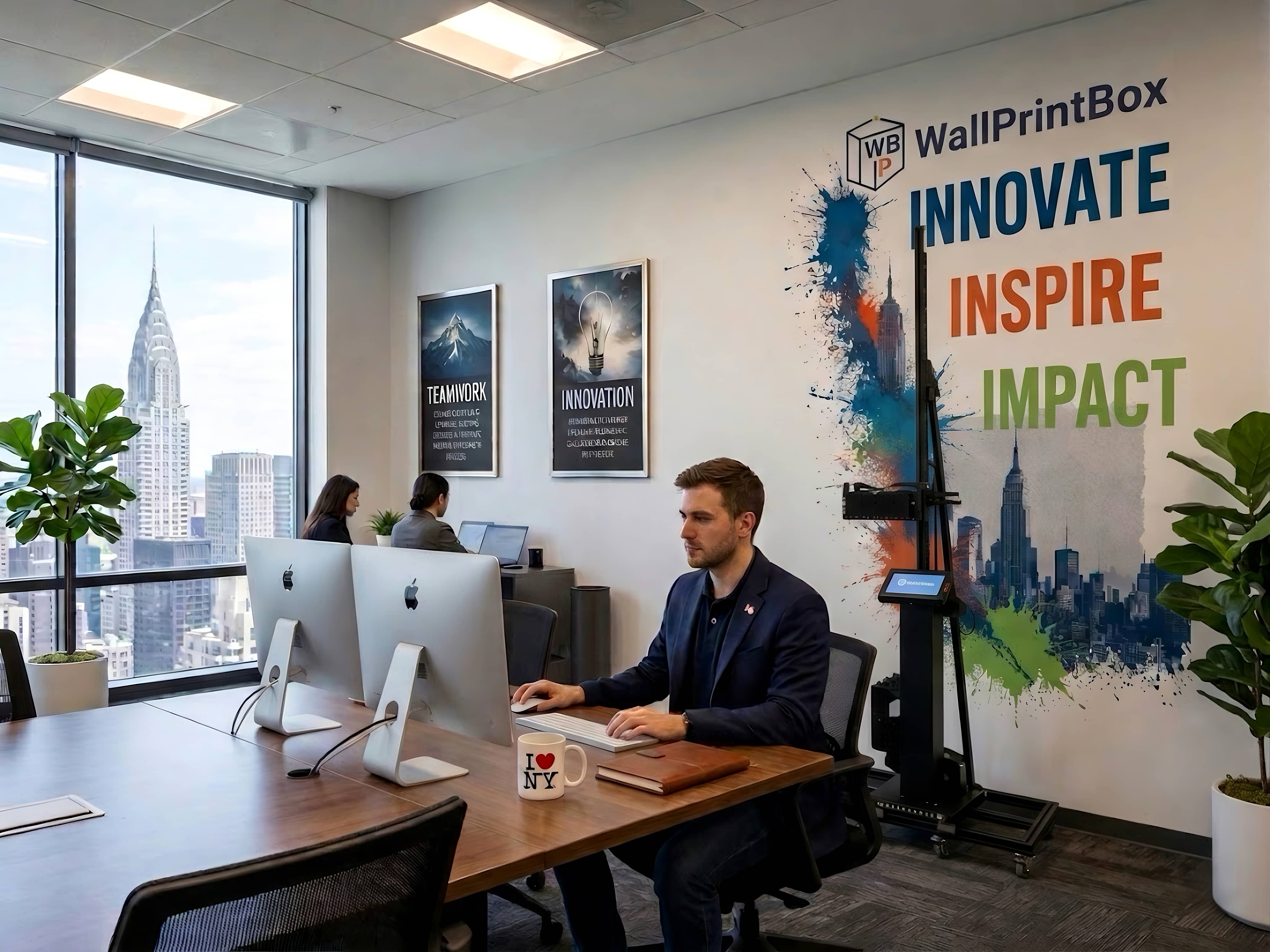
The wall printing industry runs on Chinese OEM machines. Operators who figured out the sourcing game early rebrand and resell them. wallprintbox.com fits right into that space — a "business-in-a-box" model built for solo operators, print shops, and overseas distributors. You get a functioning wall printing business, not just a piece of hardware.
The machine is Chinese-manufactured. The printhead is Epson or Ricoh. Work the margins right, and they're attractive.
What You're Buying
The baseline package includes more than most entry-level vendors offer:
1 vertical UV wall printer (Epson i3200 or i1600 head options)
RIP software license (USB dongle or online key)
Initial CMYK+W UV ink set + cleaning solution
Spare parts kit: dampers, caps, filters, fuses, driver board
Editable marketing templates (flyers, social posts, before/after print photos)
ROI calculator spreadsheet with cost-per-m² and payback modeling built in
That last item is worth paying attention to. A vendor who hands you a spreadsheet has thought through your business model — not just their invoice.
FOB Price Reality Check
Configuration | FOB China (per unit) | Est. Landed Cost (US/EU, 1 unit) |
|---|---|---|
Epson i1600 single | $5,500–$6,000 | $6,400–$7,800 |
Epson i1600 dual | $6,600–$7,500 | $7,600–$9,500 |
Epson i3200 dual | $8,300–$12,500+ | $9,500–$14,000+ |
Landed cost adds $600–$1,500 per unit for sea freight LCL, customs, and inland delivery on a single order. Order 2–5 units and that per-unit freight cost drops to $350–$800. That's your first real margin lever — before you've sold a single job.
Dealer Program: The Terms That Matter
MOQ: 1 unit for first-time buyers. Some configurations offer a "2-unit starter pack" — 1 demo, 1 resale. This opens up better pricing and a territory conversation.
Volume discount tiers: Tiers kick in at 3 / 5 / 10+ units per order or quarter, with 3–8% incremental discounts at each level. Many OEMs will lock your pricing tier for 6–12 months as long as you hit agreed annual volume. That protects you against mid-year price increases.
OEM/white-label depth: From unit 1, you can brand the chassis color, logo plate, software splash screen, and carton. Private-label model codes are available for established dealers. For resellers building a regional brand, this is a real advantage over vendor-branded programs that limit how you go to market.
Territory: Non-exclusive by default. Semi-exclusive city or regional protection becomes negotiable once you hit defined sales thresholds. Get that in writing. Verbal assurances on territory mean nothing — a second dealer could set up 40 miles away with no recourse.
Margin Math: What the Numbers Support
UV wall printing jobs price at $50–$350 per m² depending on market, substrate, and design complexity. Variable cost — ink, machine depreciation, labor — runs $5–$20 per m². That gives you 60%+ gross margins on printing jobs alone.
Add consumables revenue on top. Ink, cleaning fluid, replacement caps, and filters sold to end operators create recurring margin — no extra hardware sales needed. Extended service contracts and calibration packages add another revenue layer on top of that.
Take a single Epson i3200 unit landed at ~$10,000. Run it at modest utilization — 5–6 m² per week at $250/m² — and payback comes in under 2 months. That's a conservative number, and it holds up.
What to Check Before You Wire Anything
Printhead warranty: Many wall printer suppliers exclude the printhead from standard warranty coverage, or only cover DOA defects for a short period. Our program is more buyer-friendly: the machine body comes with a 24-month standard warranty, and the printhead is also covered under clear warranty terms when used with approved ink and proper maintenance procedures. This gives new operators more confidence before taking their first commercial job. For long-term stability, we still recommend preparing essential spare parts such as backup dampers, capping stations, ink filters, and at least one driver board.
Ink supply chain: Find out whether UV ink ships from China only, or whether regional stock exists in your market. Shelf-life, VOC certification (RoHS/REACH for EU), and batch consistency all affect color repeatability on commercial jobs.
Anti-crash sensors: Print precision on quality machines sits at ±0.5–1 mm over a 2–4 m span. Ask for sensor sensitivity specs. Find out what happens when the Z-axis hits an unexpected protrusion. Cheap machines destroy printheads here — and take your margin with them.
Price integrity: Most dealers forget to ask this question — will the OEM sell direct into your territory through their own website? Get a written commitment on dealer price integrity. No written commitment, walk away.
Best Fit
wallprintbox-style programs suit operators who want OEM flexibility, low entry cost, and the ability to build their own brand on a proven hardware base. Sign shop testing wall printing as a new revenue line? Distributor who wants white-label machines without a $25k+ commitment? The economics are real either way.
The trade-off is distance. Remote support via video call works, but it's not the same as a local tech team driving to your shop. Factor that gap into your risk planning before you commit.
WallPen
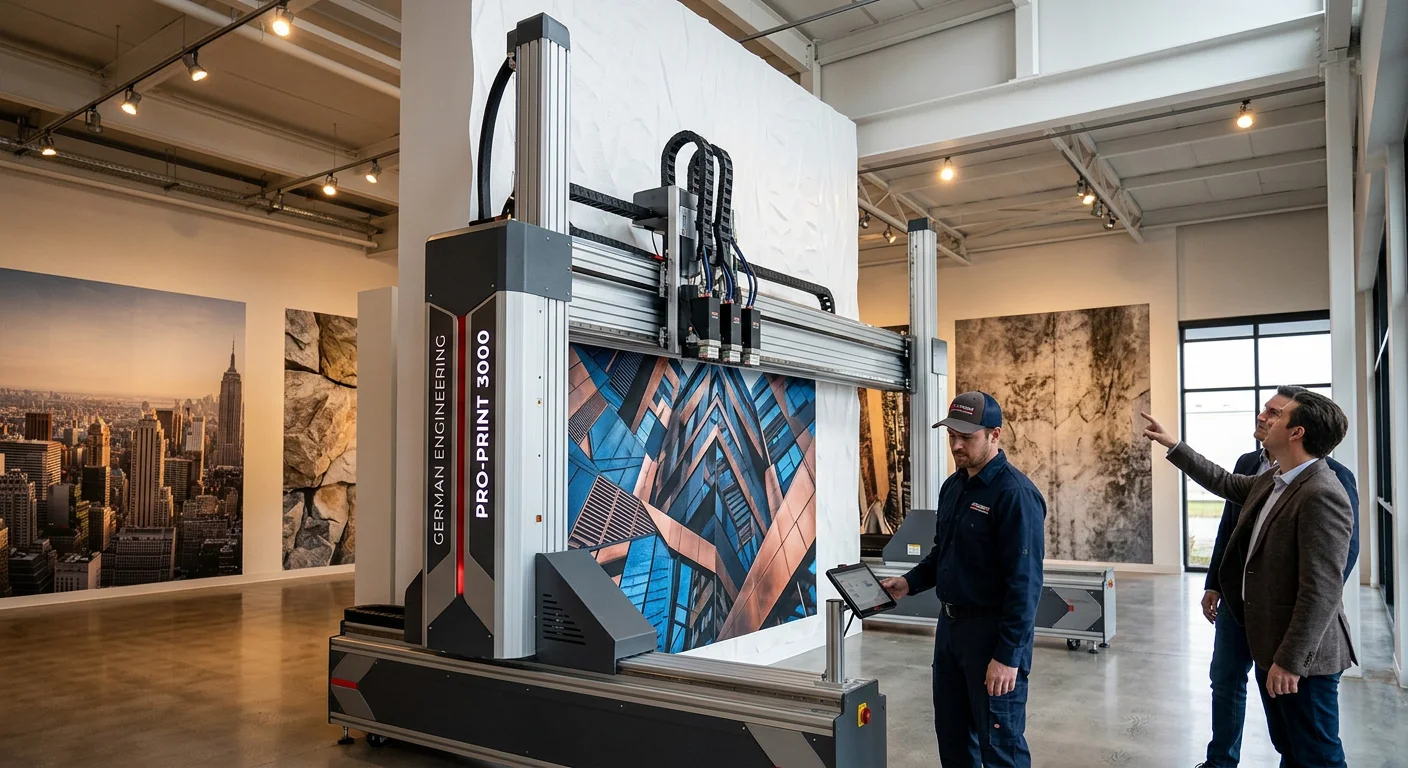
At $49,630, WallPen doesn't compete on price. It competes on pedigree.
WallPen GmbH is a German manufacturer founded in 2016 in Wissen, Rhineland-Palatinate. It's a small company — 21–50 employees, ~$2.14M estimated annual revenue — with a strong reputation in the premium tier of direct to wall printing equipment. The positioning is clear and unapologetic: "the original wall printer," 100% in-house development, Made in Germany. No excuses for the sticker price.
That starting price — $49,630, including a one-year ink flat rate — tells you exactly who this vendor is built for. Not the solo operator testing the market. Not the print shop adding a second revenue line on a tight budget. This is serious capital investment territory. It's for contractors who already know how commercial project economics work.
What You're Getting for $50k
The hardware spec earns a serious look. WallPen prints up to 4 meters (~13 ft) in height with no practical width limit. The gantry covers the full wall surface. Print technology supports CMYK, white-only, CMYKW, and W-CMYK color modes. That gives you real flexibility on dark walls, glass, plexiglass, and non-porous architectural surfaces — the kinds of surfaces where cheaper machines break down.
Distance measurement runs on integrated lasers, not operator guesswork. You can define precise z-axis limits in the software and set head distance to the millimeter. Demo footage shows 0.3 in entries with automated positioning. That level of precision — paired with print-head temperature management at 46°C — is what separates a commercial-grade install from a printer that needs constant on-site supervision.
Ink consumption sits at 5–10 ml/m², with a stated cost of $2–$5/m². The first 12 months of ink runs on a flat rate. So your ink cost is near zero while you build volume and dial in your pricing.
The 5-year warranty is the standout number here. Every other vendor in this comparison covers 12–24 months on the chassis — and most exclude printheads. WallPen's 5-year coverage changes the long-term cost picture. Add free technical support and software included in the price, and the total cost of ownership looks different than the sticker suggests.
Dealer Economics: What the Margins Support
No official dealer pricing is public. Based on the $49,630 MSRP and standard reseller assumptions for premium equipment, the inferred dealer buy price runs $32,000–$40,000. That puts the hardware margin at 20–35% — in line with the premium tier.
But the real margin story isn't the hardware spread. It's what the machine lets you charge per job.
Premium architectural murals for hospitality, corporate interiors, and institutional spaces — WallPen's core target markets — fetch $80–$150+ per m² across most North American and European markets. Stack that against a $2–$5/m² ink cost and covered machine depreciation, and your gross margin on print jobs clears 60–70% with room to spare. That's the economics this machine is built around.
Who This Fits
WallPen is a fit for established contractors with on-site experience — signage, AV installation, architectural graphics. You need to be able to sell custom large-format work into commercial accounts with long project cycles. The capital barrier is real. So is the upside on project pricing once you're inside that client segment.
For commercial wall printer cost comparisons: WallPen runs 60–80% above mid-premium North American vendors and 4–5x above Chinese OEM entry points. That price gap closes only if your market supports premium mural pricing and your clients see German engineering as part of the value.
If they do, the margin model holds up well. If they don't, there are better-matched vendors earlier in this guide.
Achiever Printers (TY Group)
Guangdong exports close to 70% of the world's wall printing hardware. Achiever printers — part of the TY Group — sits inside that supply chain as an export-focused OEM/ODM based in the Shenzhen–Dongguan–Guangzhou manufacturing cluster.
Public information on this specific brand is limited. The category they represent is well-known, though: mid-tier Chinese wall printer exporters who sell direct to overseas dealers, white-label to regional distributors, and compete hard on price against European brands. Got a quote in the $5k–$12k FOB range from a Guangdong source? You've already seen this vendor profile.
Here's how the numbers stack up.
Dealer Pricing: The Real FOB Breakdown
Configuration | FOB China | Est. Landed Cost (US/EU) |
|---|---|---|
Entry eco-solvent single-head | $3,500–$5,000 | $4,500–$6,500 |
Single-head UV (basic) | $4,500–$7,000 | $5,500–$8,500 |
Dual-head UV (mid-tier) | $7,000–$10,000 | $8,000–$11,500 |
Multi-head UV (3–4 heads) | $10,000–$15,000 | $11,000–$17,000 |
Freight, port charges, and import duty add $1,000–$2,000 per unit on small batches. Order 5+ units and that per-unit logistics cost drops noticeably. That's your first negotiation lever — before you even touch discount tiers.
Volume Discount Structure
3–5 units per year:
- 8–15% off single-unit FOB price
- Often bundled with one free spare printhead or upgraded RIP software
10+ units per year:
- 15–25% discount band
- Better payment terms (30% deposit / 70% pre-shipment instead of 50/50)
- Priority on firmware requests and free technician training
At 10+ units per year, your landed cost on a mid-tier dual-head UV machine falls into the $7,500–$9,000 range. Retail that unit at $14,000–$18,000 in a service bundle — install, training, starter ink — and your gross margin clears 40–50% without cutting prices hard.
OEM/White-Label Depth
Achiever-profile vendors earn their spot on a dealer's shortlist right here. From the first order, you can customize:
Custom logo on chassis body panels
Private-label splash screen on control software
Custom color scheme on frame
Private model numbers and nameplates
For dealers building a regional brand, that's a real advantage over vendor-branded programs that control how you go to market.
Territory protection is not standard, though. Non-exclusive by default. Defined regional exclusivity kicks in only after you commit to 20–50 units per year in writing. Verbal assurances carry no weight here. Put this clause in the contract, or expect a second dealer to show up in your market within 18 months.
Support Reality Check
Remote training via live video call covers mechanical setup, rail calibration, RIP configuration, and basic maintenance. Day-to-day debugging goes through WhatsApp or WeChat groups with 1–3 support engineers. Response time is documented at 24–72 hours on working days.
That's functional — not exceptional. The time zone gap between Guangdong and North America or Europe creates real friction during a live job crisis. Plan for a local technical resource, or stock an extended spare parts inventory before you take your first commercial contract.
Warranty terms:
- Machine frame: 12 months
- Electronics and motors: 6–12 months
- Printheads: DOA coverage only, 1–3 months — excluded from standard warranty
Before You Send a Deposit: Five Questions That Matter
Printhead brand and replacement cost — Epson i3200 runs $500–$800 FOB. Konica industrial heads run $1,500–$2,500+. Know your recurring hardware cost before you lock in a margin model.
Anti-collision sensor specs — Get the sensor type, minimum detection distance, and carriage response protocol in writing. Underpowered machines destroy printheads mid-job at this exact point.
CE/FCC compliance documentation — Ask for certificates with the test lab name and date. Check that the legal entity on the certificate matches the company you're paying.
Direct-to-market policy — Will Achiever/TY sell direct into your territory through their own channels? Get a written commitment, or assume they will.
After-sales resolution metrics — Ask for average first-response time and the number of English-speaking technical staff assigned to overseas accounts. "24-hour support" means nothing without the headcount to back it up.
Who This Vendor Fits
Achiever-profile vendors work best in price-sensitive markets where European brands are too expensive — MENA, LATAM, Southeast Asia, Eastern Europe. They also suit sign shop chains deploying multiple units across locations, or startup distributors who want to launch a branded wall printing package without a $25k+ capital commitment per unit.
The trade-off is support infrastructure. You're getting capable hardware at strong margins, with remote-only service behind it. That's a workable model — as long as you've planned for it.
National Wall Printers (DXonJet Distributor)
Regional distribution matters more than most dealers realize. National Wall Printers makes that point clear.
Located in Bay Shore, NY, National Wall Printers is the official Northeast United States distributor for DXonJet wall and floor printing equipment. That's not a self-applied label. DXonJet's own distributor directory confirms the relationship, names the territory, and lists a direct contact: Mr. Marc Eidelkind, reachable at +1 (646) 870 4000 and [email protected].
That level of traceability sets this apart from the anonymous Alibaba listings you've been sorting through.
What the Distribution Model Looks Like
DXonJet manufactures in China. The company runs sales, training, and technical support worldwide. So National Wall Printers operates inside a structured channel program — not just reselling commodity hardware.
DXonJet's public materials focus on service across multiple channels:
- Website
- Email
- WhatsApp
- Zoom scheduling
That same service approach carries through the distributor layer.
Some details you won't find in public materials:
- Dealer contract terms
- FOB pricing tiers
- Territory exclusivity clauses
- Co-op marketing rules
- Warranty language
Those details require a direct commercial conversation with Marc's team. Plan for that call before you go further.
Pricing Anchor: Where DXonJet Equipment Sits
The best public benchmark available puts the DXonJet VPJet4.0 in the $9,000–$15,000 range (2026 buyer's guide data). That places DXonJet hardware in the mid-tier Chinese OEM bracket — above entry-level eco-solvent machines, and well below WallPen's $49k threshold.
For a wall inkjet printer distributor looking at the Northeast U.S. market, this price range offers a solid entry point. You get room to build a real hardware margin — as long as you negotiate landed cost, not just FOB.
The gap to close: territory exclusivity terms and dealer discount depth stay unclear until you open a direct conversation. That's the first call to make.
Conclusion
You've done the research. You've seen the numbers. One decision separates you from a profitable wall printer dealership.
Here's the core takeaway: not every vendor offering dealer pricing on wall printers deserves your capital or your trust. The gap between a $40K first year and a $400K operation isn't the machine. It's the supplier relationship. MOQ flexibility, real territory protection, a training program that stays with you after the wire clears — these details add up fast.
The right vendor is out there. From The Wall Printer's reseller program to the raw-margin potential inside Guangdong's direct-to-wall OEM factories, there's a match for your budget, your market, and your growth plan.
So use the scoring framework. Run the profit model. Send three RFQs this week.
The dealers winning right now didn't wait for perfect information. They moved on good information, fast.
That's what you have right now.
Ready to build your wall printer dealership? Contact us today to discuss dealer pricing, OEM options, training support, and a growth plan for your local market.