Wallpaper murals, vinyl wall graphics, and direct wall printing can all transform a blank wall into a custom design. However, they solve different problems and suit different types of projects.
Wallpaper focuses on decorative texture and premium interior finishes. Vinyl is quick to install, easy to remove, and practical for temporary graphics. Direct wall printing uses a wall printer to apply photographs, illustrations, logos, and text directly to the surface without wallpaper panels, adhesive film, or paste.
Before choosing a method, consider four questions:
How long should the mural remain in place?
Will it need to be removed or replaced?
What material, texture, and condition is the wall?
Is decorative texture or a seamless custom image more important?
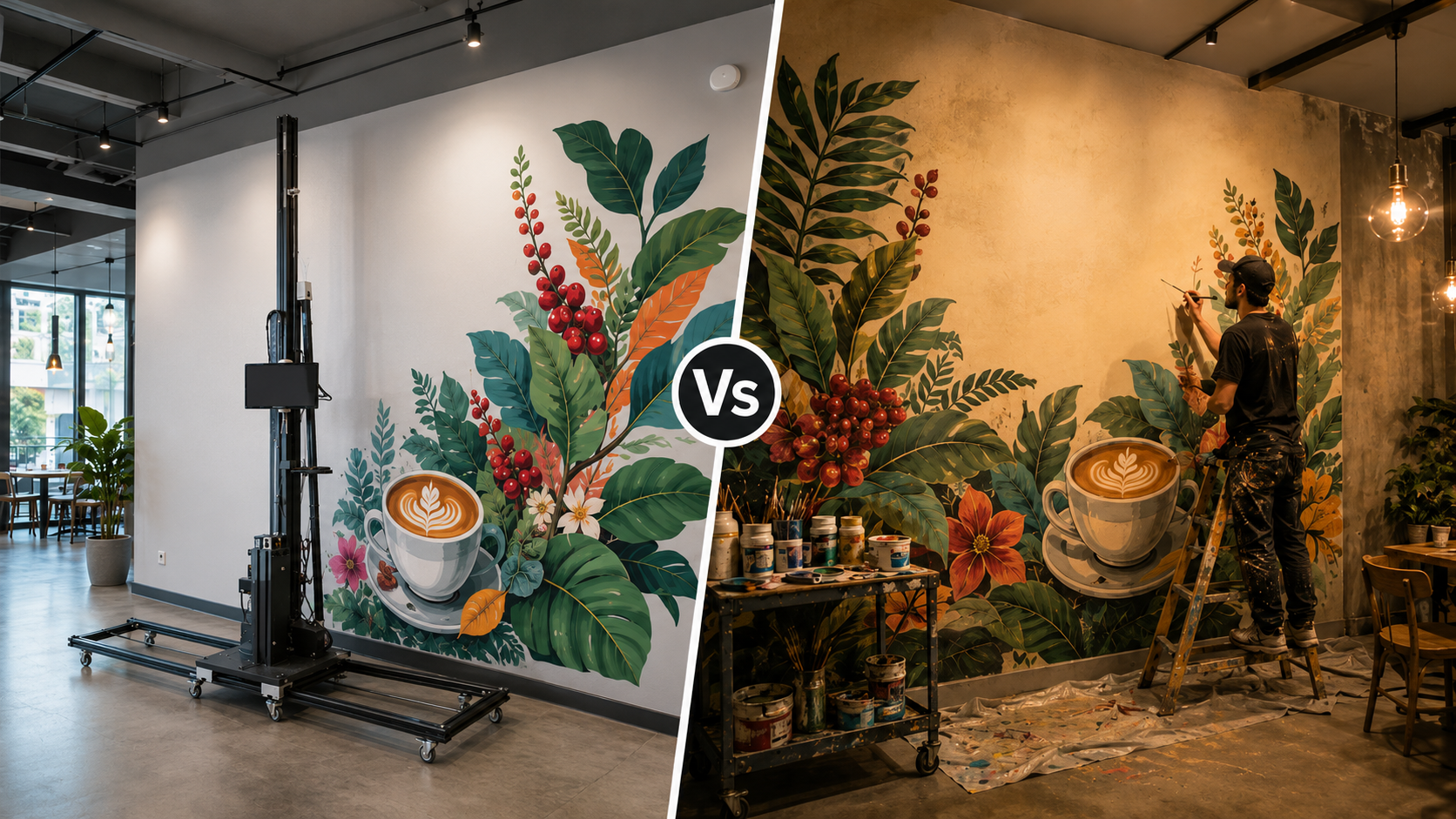
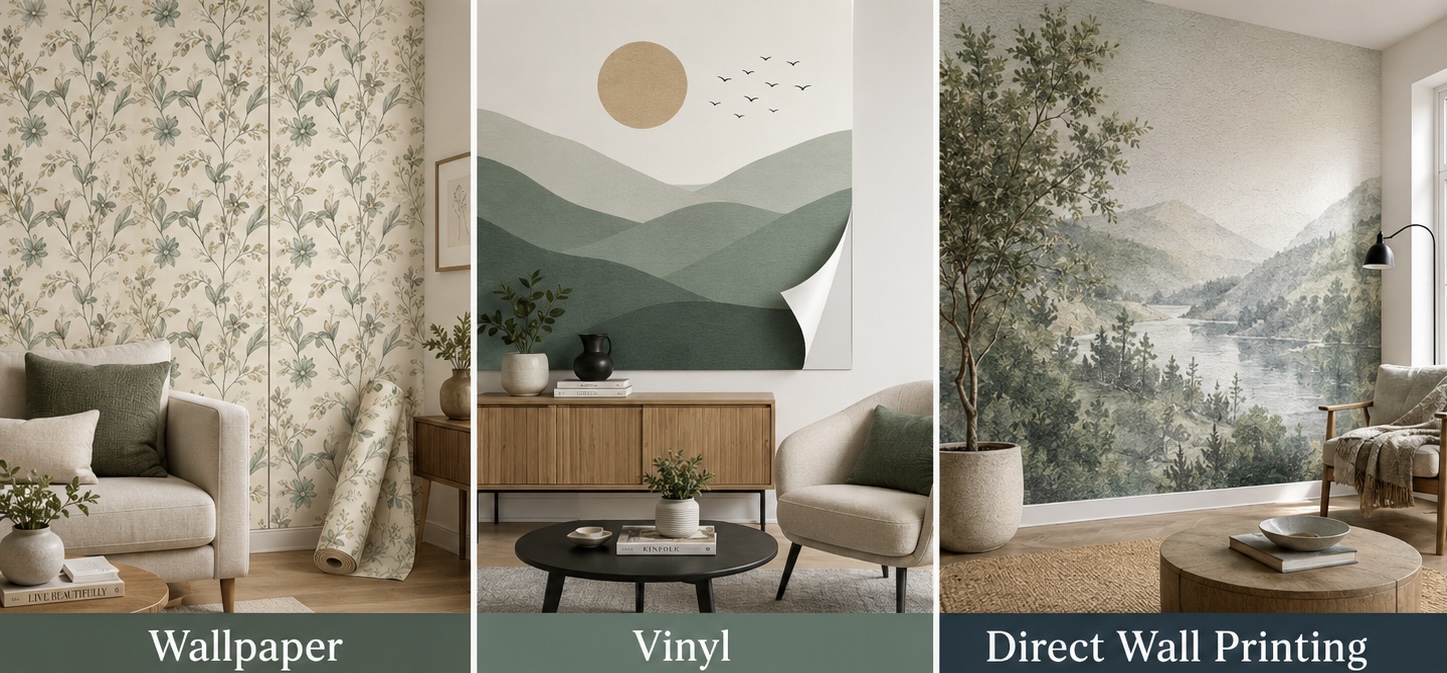
Wallpaper vs Vinyl vs Direct Wall Printing
Comparison Factor | Wallpaper Mural | Vinyl Wall Graphic | Direct Wall Printing |
|---|---|---|---|
Best for | Premium homes, hotels, and long-term interior decoration | Trade shows, promotions, pop-up stores, and temporary branding | Custom murals, brand walls, and large commercial surfaces |
Installation | Printed in panels and pasted to the wall | Self-adhesive film applied to the surface | Image printed directly onto the wall |
Seams | Usually present | May appear on large installations | No material seams |
Removability | Moderate; removal may be difficult | Usually the easiest to remove and replace | Normally covered by repainting or surface preparation |
Wall requirements | Smooth, dry, and suitable for adhesive | Smooth, clean, and lightly textured | Clean and stable; can tolerate some surface texture |
Main advantage | Wide range of decorative materials and textures | Flexible, fast to install, and easy to update | Seamless, highly customizable, and suitable for more materials |
Main limitation | Seams, adhesive, and installation accuracy | Limited on rough walls; edges may lift | Requires professional equipment and sufficient working space |
Choose wallpaper for material texture, vinyl for removability, and direct wall printing for seamless customization and on-site production.
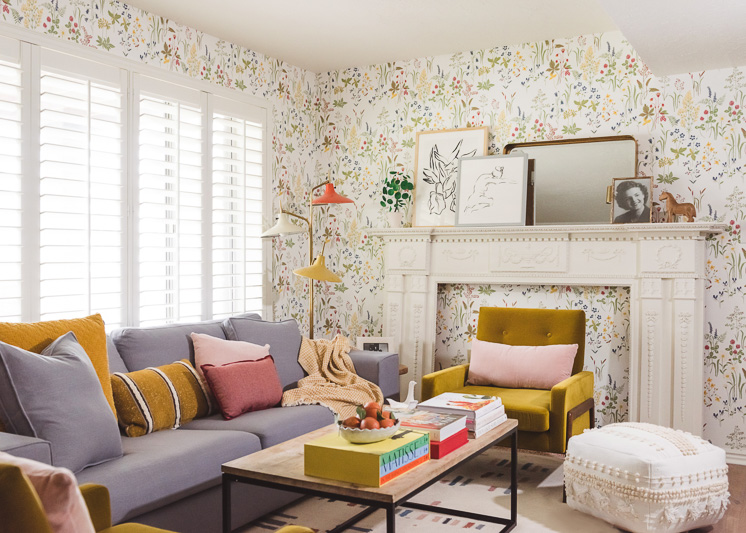
Wallpaper Murals: Best for Textured, Long-Term Interiors
A wallpaper mural is produced by dividing a complete image into several printed panels. The panels are then installed next to one another using paste or pre-applied adhesive.
Wallpaper can be produced on non-woven paper, fabric-backed material, canvas textures, metallic finishes, and natural-fiber-style surfaces. It is therefore well suited to bedrooms, living rooms, restaurants, boutique hotels, and other interiors where material feel is an important part of the design.
Advantages of Wallpaper Murals
A wide range of material textures
Wallpaper can reproduce woven fabric, paper, grasscloth, metallic, and natural-fiber effects. When a project depends on tactile quality and a layered interior finish, this is an advantage that ordinary vinyl and direct ink printing cannot fully reproduce.
Suitable for long-term indoor decoration
High-quality wallpaper can remain attractive for years when installed on a properly prepared wall in a stable indoor environment.
The finished material can be inspected before installation
Because printing takes place in a factory or studio, the client can review the material, color, and image quality before the installation begins.
It can soften minor wall imperfections
Thicker wallcoverings may disguise small surface defects, although they cannot correct moisture, serious cracking, or unstable plaster.
Limitations of Wallpaper Murals
Large murals normally have seams
Professional installation can make panel joints less visible, but side lighting, complex patterns, and inaccurate alignment may still reveal them.
The result depends heavily on preparation and installation
Moisture, dust, loose paint, unsuitable paste, or poor alignment can cause bubbling, lifting edges, or separated seams.
Limited flexibility for on-site changes
Wallpaper is manufactured to a predetermined size. If the wall measurements, door positions, or image proportions change, the panels may need to be recut or reproduced.
Removal may damage the underlying wall
Strong adhesive can pull away paint or surface coatings, increasing the cost of future repairs.
When Should You Choose Wallpaper?
Wallpaper is usually the best choice when the client wants a specific material texture, the mural will remain for several years, the wall is smooth, and professional installation is available.
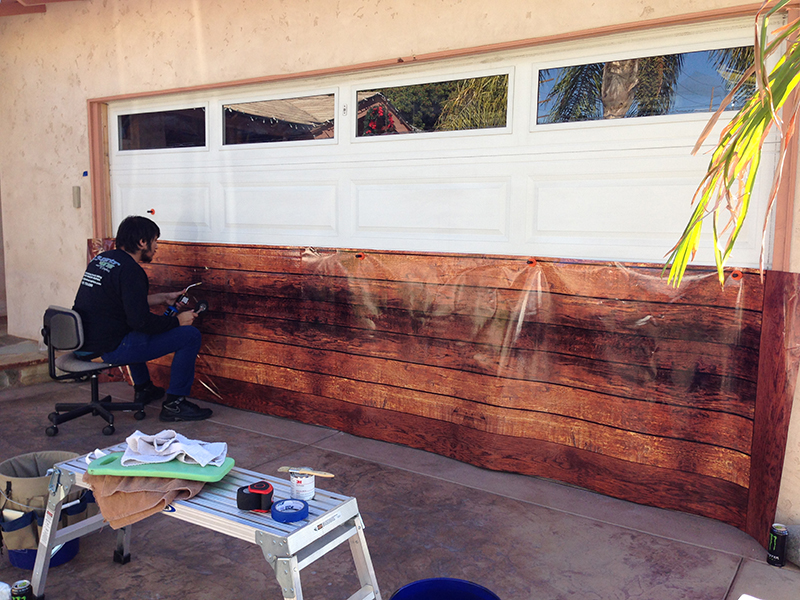
Vinyl Wall Graphics: Best for Temporary Displays and Frequent Updates
Vinyl wall graphics are printed on self-adhesive film and applied to walls, exhibition panels, or display structures.
They are widely used for trade shows, retail promotions, pop-up stores, office logos, product launches, seasonal campaigns, and rented commercial spaces.
Advantages of Vinyl Wall Graphics
Fast installation and relatively easy removal
Unlike traditional wallpaper, vinyl normally does not require wet paste. This makes it practical when installation time is limited.
Suitable for temporary or frequently changing content
Promotional messages, seasonal artwork, and product information can be removed and replaced as campaigns change.
Effective for logos, lettering, and commercial graphics
Vinyl can be contour-cut into individual logos, text, and QR codes, or printed as a larger wall graphic.
Optional protective laminates
Matte, gloss, anti-glare, or scratch-resistant laminates can improve cleanability and short-term durability.
Limitations of Vinyl Wall Graphics
It requires a relatively smooth surface
Brick, rough concrete, textured paint, and dusty walls reduce the contact area of the adhesive, increasing the risk of bubbles, lifting edges, or failure.
Large graphics may still require multiple sections
When the design exceeds the material width, seams or overlapping edges may become visible under strong lighting.
Removable does not always mean damage-free
Fresh paint, weak existing coatings, or an unsuitable adhesive may peel away during removal.
The finish can appear more commercial
Smooth vinyl is well suited to branding and promotional graphics, but it may not provide the natural or premium texture expected in some residential interiors.
When Should You Choose Vinyl?
Vinyl is usually the most practical option when the design will remain for only a few weeks or months, the wall is smooth, and easy replacement matters more than permanence.
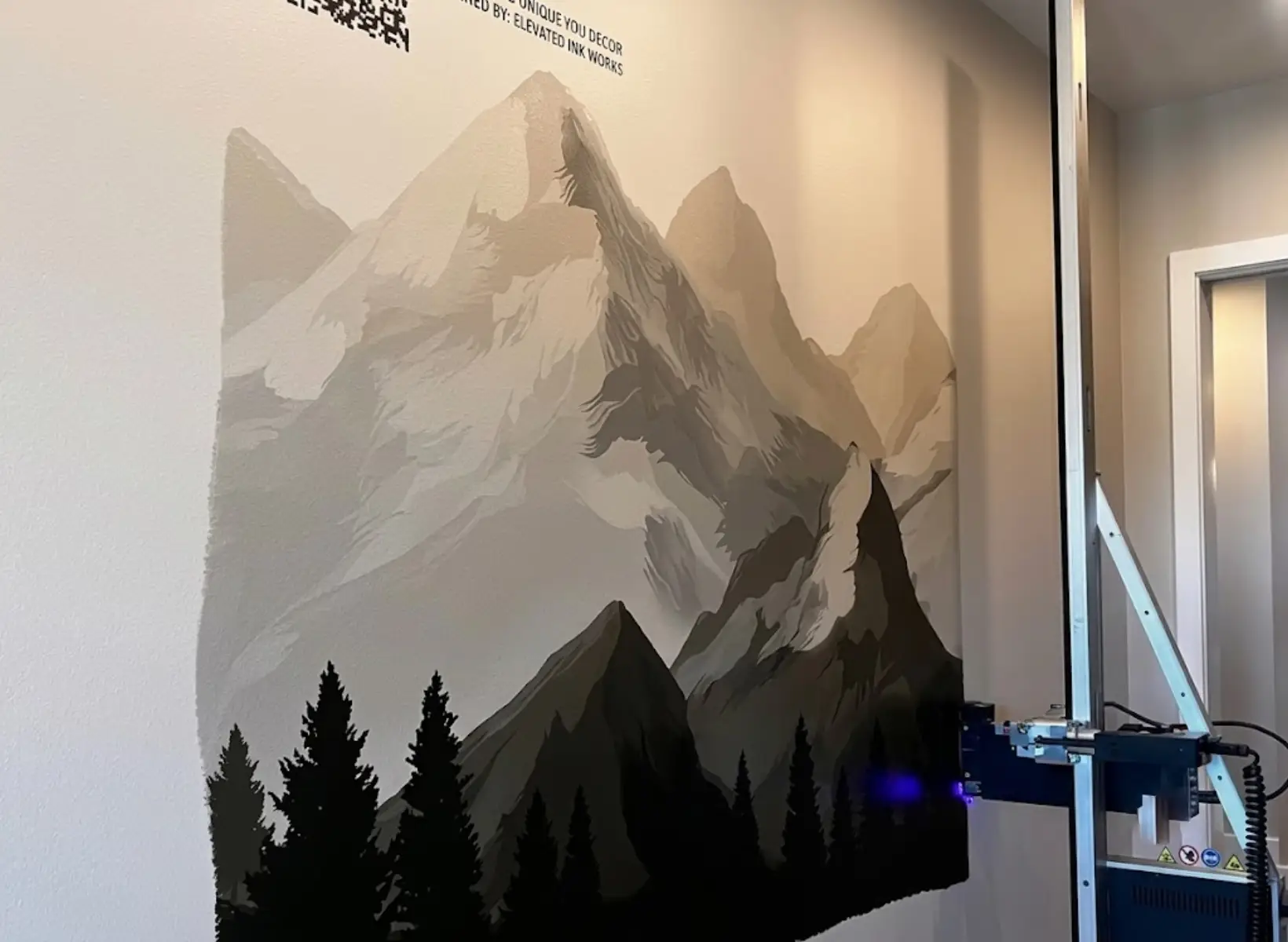
Direct Wall Printing: Best for Seamless Custom Murals
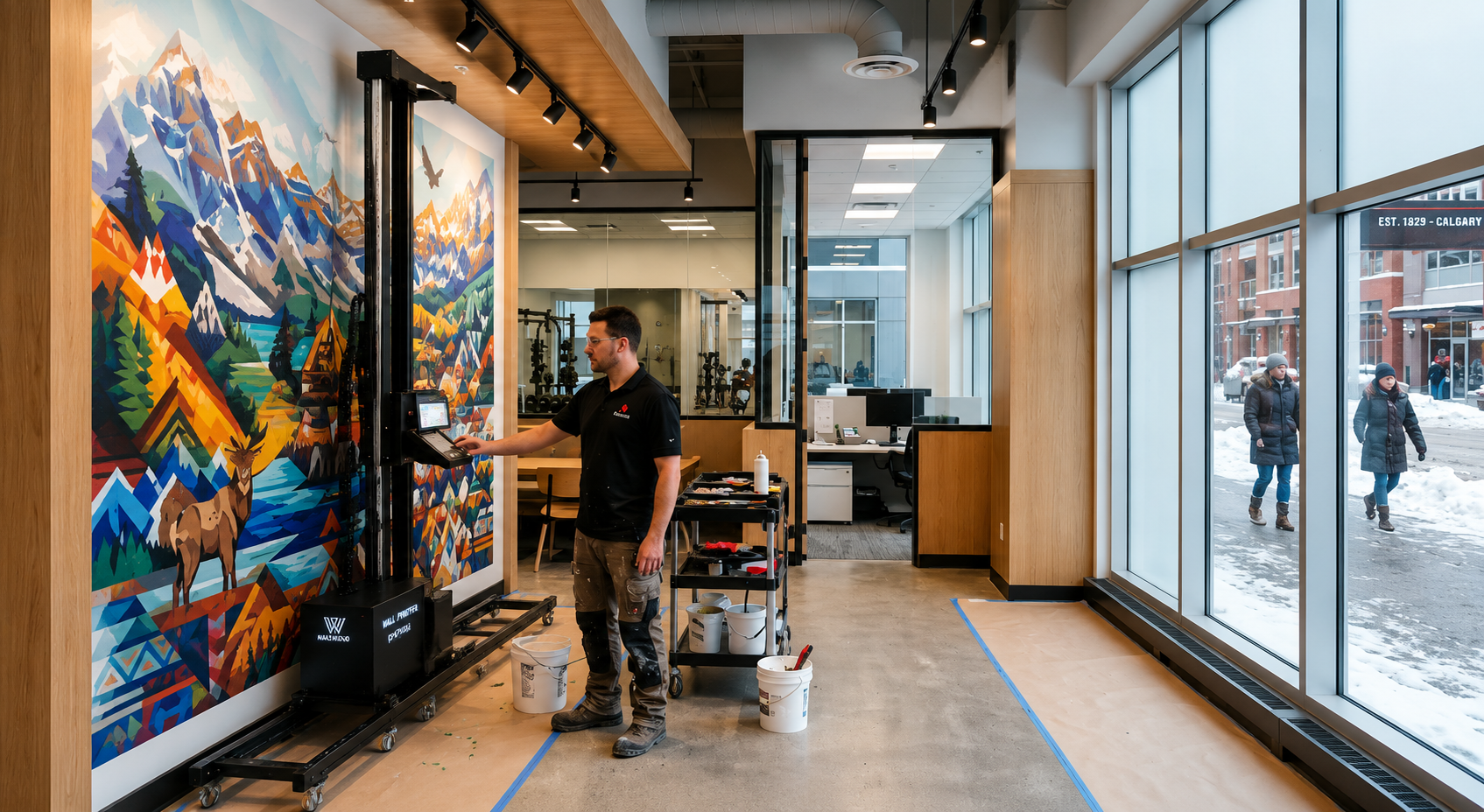
Direct wall printing uses a vertically operated wall printer to apply the artwork directly to the surface.
It does not require wallpaper panels, adhesive film, or on-site paste. The wall itself becomes the printing substrate.
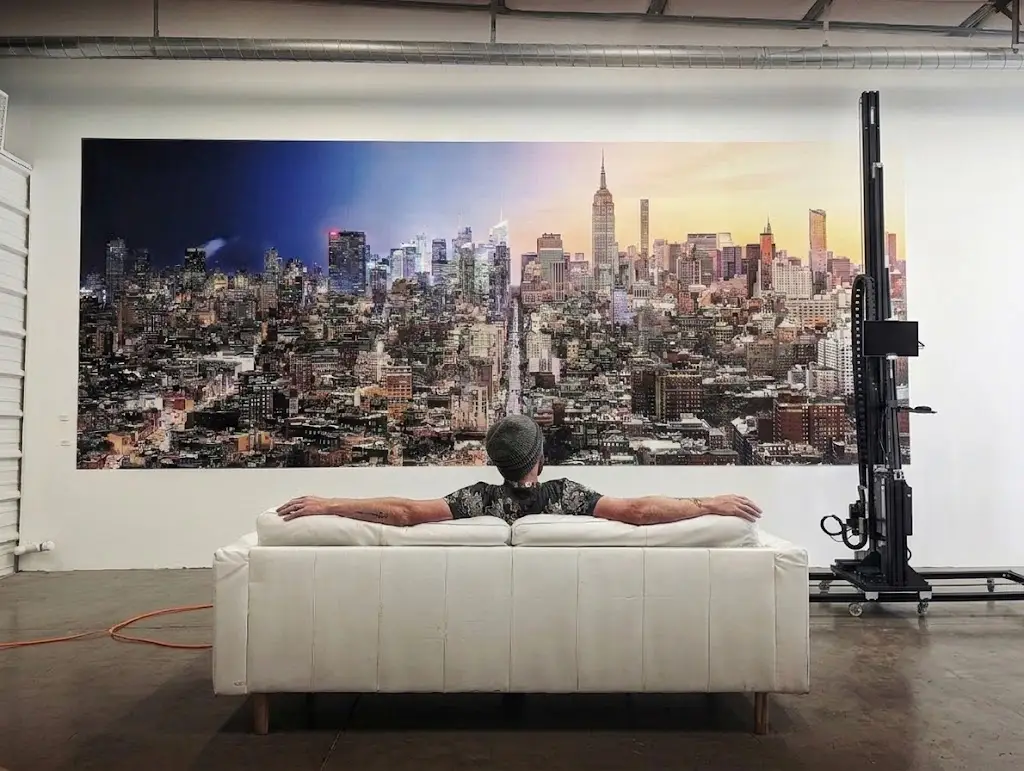
Modern UV wall printers can reproduce photographs, illustrations, gradients, logos, text, QR codes, and complex branded graphics. Machines equipped with white ink can also print on dark walls, colored surfaces, glass, and selected specialty materials.
Advantages of Direct Wall Printing
No material seams
The design is printed directly onto the wall, so there are no wallpaper panel joints, overlapping vinyl edges, or adhesive lines.
This is especially valuable for large photographs, continuous gradients, branded artwork, and detailed illustrations.
Flexible adjustment to the actual wall
The image can be positioned around doors, windows, electrical outlets, furniture, and architectural features.
If the client changes the size or placement before printing, there is normally no need to reproduce an entire set of wallcovering panels.
Suitable for a wider range of materials
After appropriate testing and preparation, a UV wall printer may print on:
Painted walls;
Plaster;
Wood;
Brick;
Concrete;
Glass;
Ceramic tile;
Metal.
Fewer production and installation stages
Wallpaper and vinyl must be manufactured, packed, transported, aligned, and installed. Direct wall printing can begin on-site once the artwork and wall preparation are complete.
Consistent reproduction across multiple locations
The same digital file can be used in several hotels, stores, offices, or restaurants, making it easier to maintain consistent dimensions and brand visuals.
Commercial value for decoration and advertising companies
A wall printer allows contractors, sign companies, and mural businesses to bring previously outsourced wall graphics in-house.
Limitations of Direct Wall Printing
It is not designed for frequent removal
Because the image is printed directly onto the surface, changing it usually requires repainting or preparing the wall for a new design.
Professional equipment and training are required
Print quality still depends on the printhead, ink system, RIP software, wall-distance sensing, DPI, pass count, calibration, and operator technique.
However, operating a wall printer does not have to require extensive printing experience. WallPrintBox is designed to make the learning process straightforward, with guided setup, operating training, preset workflows, and ongoing technical support that help new users understand the core printing process more quickly.
Once the operator learns wall preparation, artwork setup, machine calibration, and basic maintenance, most routine mural projects can follow a repeatable workflow.
The machine needs sufficient working space
Fixed furniture, narrow corridors, steps, uneven floors, and equipment close to the wall may restrict machine access and movement.
It cannot replace basic wall repairs
Moisture, severe cracks, loose paint, powdering surfaces, and unstable plaster must be repaired before printing.
The original wall texture remains visible
An image printed on brick or concrete will follow the existing surface texture. It will not look as smooth as the same image printed on prepared drywall.
When Should You Choose Direct Wall Printing?
Direct wall printing is usually the strongest option when the project requires a seamless image, precise customization, large photographs, brand graphics, multiple surface types, or reduced reliance on panel production and adhesive installation.
Which Method Is Best for Different Projects?
Premium Homes and Hotels
Choose wallpaper when fabric, paper, or natural-fiber texture is central to the interior concept.
Choose direct wall printing when the project requires a seamless photograph, artwork, or highly customized feature wall.
Trade Shows, Pop-Up Stores, and Temporary Promotions
Choose removable vinyl.
It installs quickly, can be removed after the event, and is well suited to changing promotional content.
Restaurants, Offices, and Retail Brand Walls
Direct wall printing often provides the strongest result.
Large photographs, logos, branded illustrations, and gradients can be printed directly onto the wall without panel seams.
Brick, Concrete, and Textured Walls
Direct wall printing is generally more practical than applying large adhesive sheets because the image can follow the original wall texture.
A sample print is still necessary to confirm image detail and ink adhesion.
Commercial Spaces With Frequently Changing Content
Choose vinyl.
When promotions, products, and seasonal themes change regularly, easy removal is more important than a permanent seamless finish.
What Should You Check Before Choosing a Method?
For a mural project, confirm:
Wall dimensions and material;
Surface texture and existing paint condition;
Moisture, cracking, or powdering;
Expected lifespan;
Whether removal will be required;
Artwork resolution;
Available installation space.
Businesses considering a wall printer should also verify:
Printhead model and ink configuration;
White-ink capability;
Effective print height;
Real speed in standard-quality mode;
DPI and pass count;
Automatic wall-distance sensing;
Performance on textured walls;
Transportation and assembly time;
Software, training, and warranty terms;
Printhead and spare-parts prices.
Do not rely only on finished sample photographs supplied by the manufacturer.
Ask the supplier to complete an unedited timed test using your artwork and a wall material common in your market. The demonstration should show setup, calibration, print settings, actual speed, and close-up details.
A complete test on a real material is more valuable than maximum DPI or advertised speed.
Conclusion
Wallpaper, vinyl, and direct wall printing each have clear advantages and limitations.
Wallpaper offers the widest range of decorative materials and premium interior textures, but it requires precise installation and normally includes panel seams.
Vinyl is fast to install, easy to replace, and well suited to temporary graphics, but it performs best on smooth walls and may develop visible seams or lifting edges.
Direct wall printing provides seamless customization, on-site flexibility, and broader material compatibility, but it requires professional equipment, sufficient working space, and proper wall preparation.
For decoration companies, sign businesses, and mural entrepreneurs, bringing direct wall printing in-house can reduce outsourcing, shorten project lead times, and open up new residential and commercial applications.
Ready to evaluate whether a wall printer fits your business? Send WallPrintBox photos of your common wall surfaces, typical mural dimensions, expected monthly workload, and delivery country. We will recommend a suitable printhead and ink configuration, arrange a sample print on a comparable material, and provide an itemized delivered quotation so you can assess the investment with real project data.