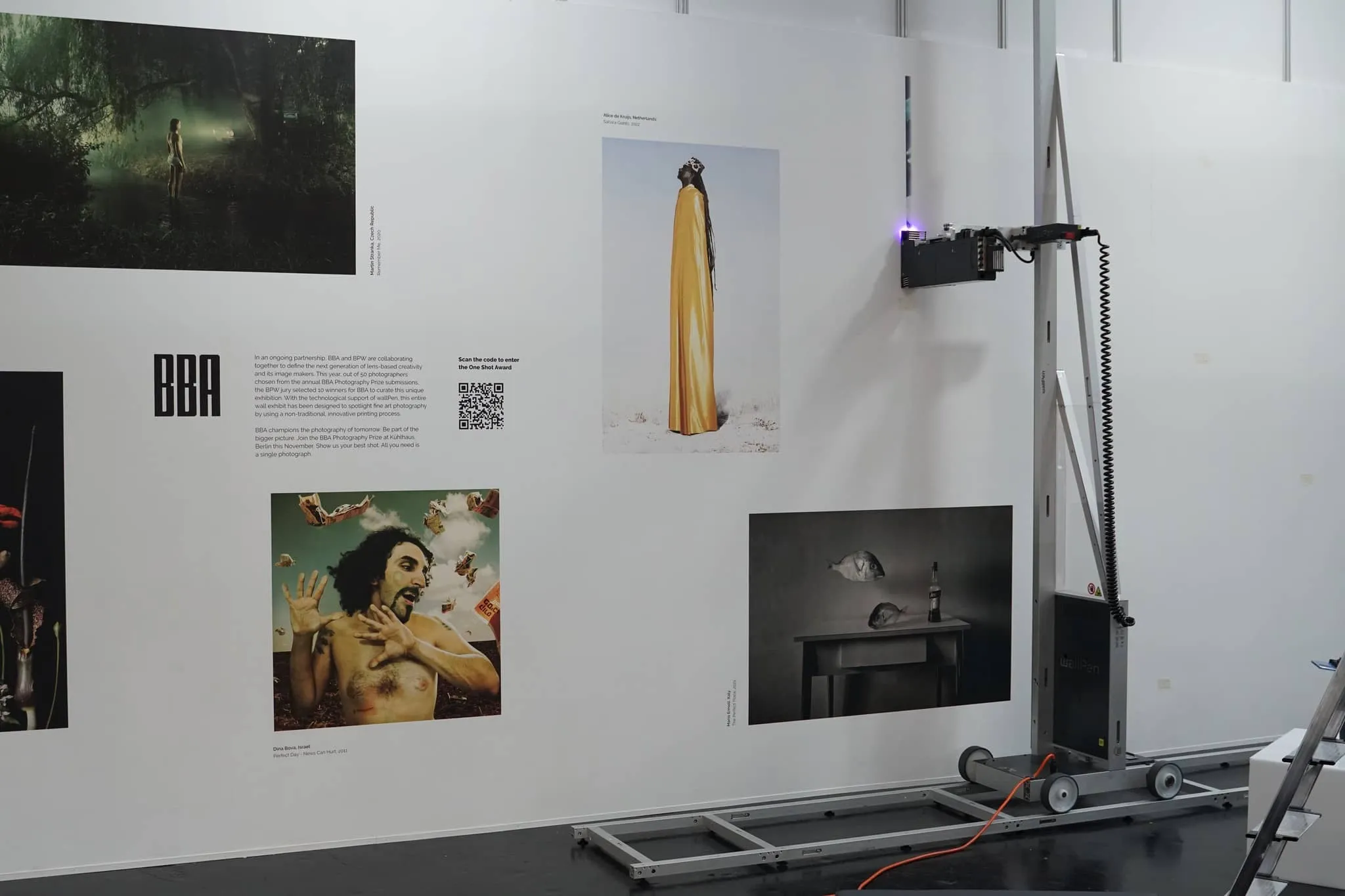
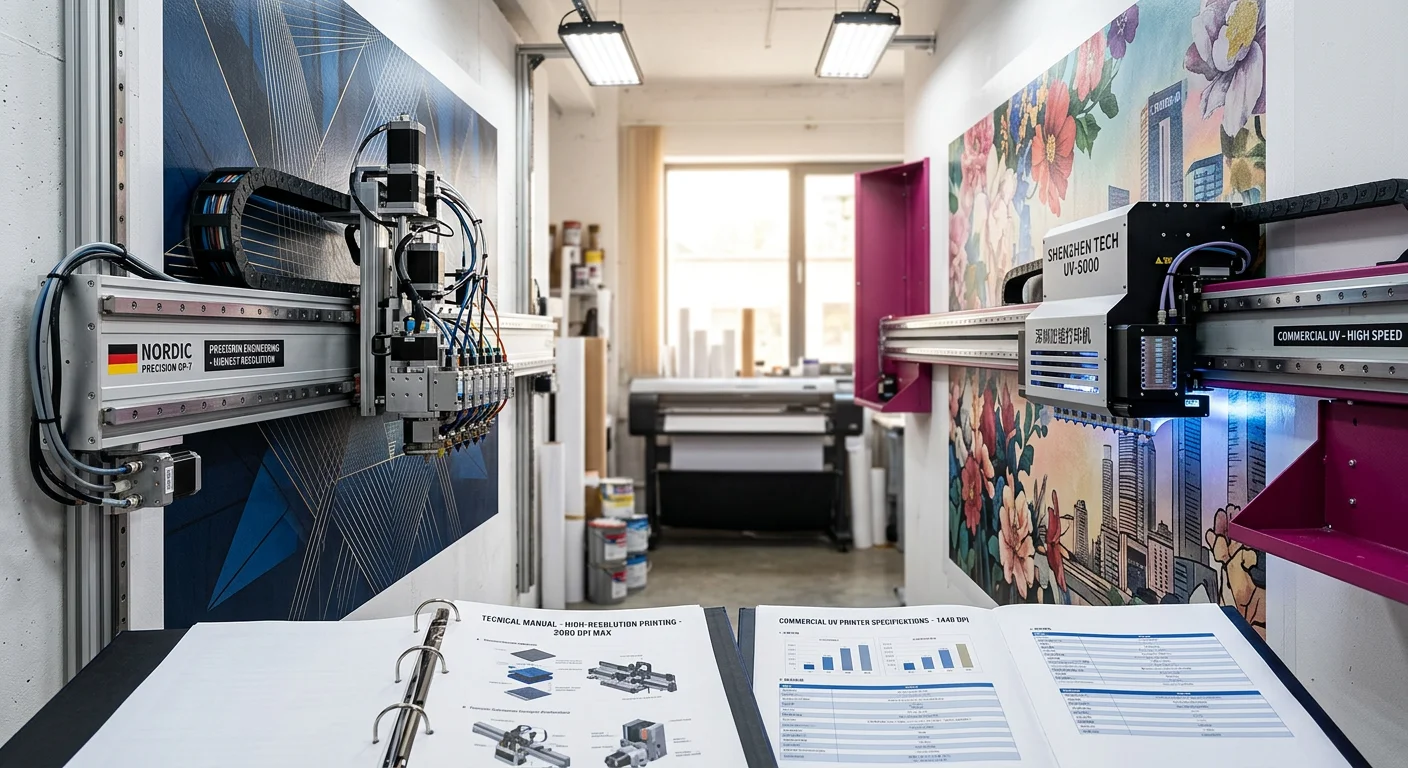
Most wall printing machine manufacturers won't publish their prices — and Wallpen is no different. You'll find plenty of glossy product pages. But the moment you want an actual number, you get redirected to a "request a quote" form. That's frustrating when you're trying to make a real business decision.
So before you fill out that form, here's what you need:
A full breakdown of what Wallpen machines cost across different models
What the total bill looks like once you factor in ink, installation, and maintenance
Whether the numbers make sense for your situation
This guide runs the full Wallpen ROI calculation. You'll walk into that sales conversation already knowing your answer.
Wallpen Model Pricing and Configuration Comparison
Three numbers define Wallpen pricing: $49,630, $58,555, and $65,000. Each one represents a different version of what you'll pay. The gap between them is what you need to understand.
The Base Price vs. What You'll End Up Spending
The factory-direct starting price is $49,630 USD. That's not a stripped-down teaser number. It covers the machine, standard operator training, and a 12-month ink flat rate. So all your ink consumables for the first year are bundled in. For a vertical wall printer, that's a solid base package.
But most buyers don't stop at $49,630.
The realistic all-in figure lands between $58,000 and $65,000. That's after you add shipping, pro software, extended support, and any dealer margin. Wallpen's own financing example puts it plainly: a sample quote shows $58,555 financed over 36 months at 5%, working out to $1,708/month. That ~$9k gap above the base price comes from logistics, accessories, and regional add-ons. These costs never show up on a product page.
Independent reviewers push the ceiling even higher. A video review of the Wallpen E2 puts the North American buy-in at "around $65,000 USD, plus shipping costs, plus software subscription." A third-party comparison site lists a wider range of $40,000–$60,000, depending on configuration and region. Combined with distributor data, the realistic street range for a deployed unit sits at $50k–$65k.
What You Get at Each Price Point
Configuration Tier | Estimated Price (USD) | What's Included |
|---|---|---|
Factory direct base | ~$49,630 | Machine + 12-month ink flat rate + training |
Typical dealer bundle | ~$55,000–$58,000 | Above + local shipping + on-site install |
Full-spec E2 | ~$60,000–$65,000 | Above + Pro software + extended support + accessories |
A few specs worth knowing at any price point:
The E2 prints up to 4 meters (13 ft) high with unlimited width
It runs Ricoh GH2220 printheads — five units, each replaceable at ~$600
Top-end speed hits 5–6 m²/h in theory. Real-world mural production runs closer to 2–3 m²/h at quality-grade resolution
One recurring cost that buyers often miss: after year one, Pro software renews at $27/year. The cost is small, but get it confirmed in writing before you sign.
Total Cost of Ownership Itemized Checklist

The wall printing machine price is the smallest number on your invoice. That's not a knock on Wallpen — it's true of every industrial printing system. The buyers who get surprised aren't the ones who paid too much for the machine. They're the ones who forgot to count everything else.
Here's every cost line you need to account for before you commit.
The 8-Item TCO Breakdown
1. Base Hardware
Your machine purchase price: $49,630–$65,000 depending on configuration and region. Year-one ink comes bundled in the base package. That offsets a solid chunk of your first-year consumable spend. Don't double-count it.
2. Shipping, Import Duties & Logistics
Industrial equipment shipped across borders adds 5–15% of the FOB value in freight, customs, brokerage, and port handling. On a $55,000 unit, that's $2,750–$8,250. Importing a single machine via LCL (less-than-container load)? Expect costs at the upper end of that range. FCL shipments for larger orders run leaner.
Also factor in:
- Marine insurance
- Import duty by HS code
- Any VAT or GST applied to the CIF value
None of these fees appear in any product brochure.
3. On-Site Installation & Commissioning
Standard commissioning (1–3 days) comes included in your purchase package. What's not included: expedited dispatch, off-hours setup, or site-specific engineering. Independent onsite technical labor runs $1,000–$2,000/day, plus travel. Set aside a buffer of $500–$1,500 for edge cases — rigging fees, site access permits, or power conditioning requirements.
4. Operator Training
Factory training or remote onboarding ships with the unit. Need additional onsite operator classes or a second training session after staff turnover? Plan for day-rate fees plus travel. Build in at least $300–$800 as a contingency line.
5. Post-Year-1 Service Contract
Year one support is covered. After that, you're on your own unless you buy a service contract. Industry benchmarks for industrial print systems put maintenance contracts at 8–15% of hardware cost per year. On a $55,000 machine, that's $4,400–$8,250 per year.
Be clear on what response time you're buying. Next-business-day onsite and 4-hour emergency response are very different SLA tiers — and the price gap between them is real.
6. Wear Parts Reserve
Five Ricoh GH2220 printheads at $600 each puts a full head set replacement at ~$3,000. Industrial-grade piezo heads on comparable wide-format systems run $1,000–$2,000 per head, so Wallpen's figure is on the competitive end. Beyond heads, budget an annual allowance for:
Rail and bearing kits: $200–$1,000 per assembly (replaced every 2–3 years)
Encoder strips and sensor kits: $200–$500
Alignment and calibration tools: $200–$500
A realistic wear-parts reserve runs $1,200–$2,500/year once you spread it out.
7. Software & Licensing
Pro software renews at $27/year — close to nothing. The real question is whether you'll need additional RIP licensing, cloud job management, or workflow integration tools as your business grows. Set a baseline of $50–$200/year for software, and revisit that number if your operation scales.
8. Ongoing Consumables
After year one, ink is no longer bundled. Wall printing ink costs shift with coverage and ink type. For UV or solvent-based systems, ink is the dominant recurring variable cost — plan around it.
Also add:
- Primer or pre-coat for certain substrates
- UV cleaning solutions
- Capping station wipes
- Waste ink containers
- Protective varnish, if your clients need it
In production printing, substrates and consumables combined take up 50–60% of the job cost. Wall printing runs lower on substrate since the wall belongs to the client. But ink and prep materials still need a real budget line.
Annualized TCO Summary Table
Cost Category | Year 1 Estimate | Year 2+ Annual Estimate |
|---|---|---|
Hardware (amortized over 5 yrs) | $11,000–$13,000 | $11,000–$13,000 |
Shipping, duties & logistics | $2,750–$8,250 | — |
Installation & commissioning | Included / $500–$1,500 buffer | — |
Service contract | Included year 1 | $4,400–$8,250 |
Wear parts reserve | $500–$1,000 | $1,200–$2,500 |
Software & licensing | $27–$200 | $50–$200 |
Consumables (ink, fluids, prep) | Bundled in base | $3,000–$6,000+ |
Estimated Annual Total | $15,000–$24,000 | $19,650–$29,950 |
The jump in Year 2+ is real — and it's the number most people don't have when evaluating the deal. Run your revenue projections against the Year 2 cost floor, not Year 1. That's the number that tells you whether this business holds up.
Per-Square-Meter Operating and Ink Cost Realities
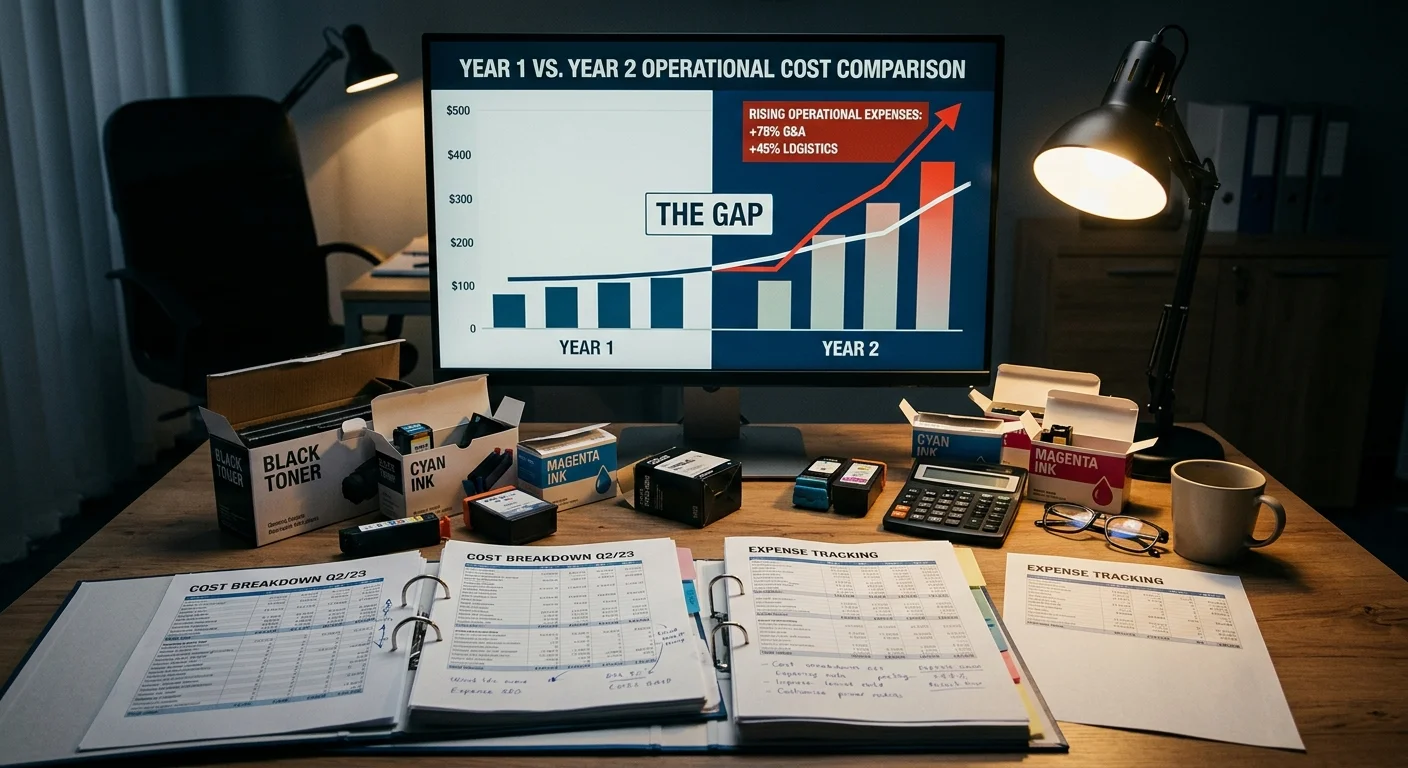
Ink is where your margin lives or dies. Most buyers don't figure that out until year one's bundled supply runs out.
The flat-rate ink period ends. After that, you're buying at market rates and building that cost into every job you quote. Getting this number wrong by even $2–$3/m² adds up fast across a full month of work.
What Ink Actually Costs Per Square Meter
Ink usage shifts a lot based on coverage density. Field data from multiple wall printing operators shows a realistic range of 5–30 ml/m²:
Light branding graphics and logos: 5–10 ml/m²
Moderate coverage murals: 10–15 ml/m²
Full-color decorative art walls: 20–30 ml/m²
One documented US operator case: a 40 ft² (≈3.7 m²) wall used ~100 ml of ink total. That works out to ~27 ml/m² at high-coverage decorative output. At a market ink price of $160/L — which matches what independent wall printer operators report — that single job carried an ink cost of ~$4.30/m².
Put that into a working budget:
Coverage Level | Ink Usage | Ink Cost @ $160/L |
|---|---|---|
Light graphics / branding | ~5 ml/m² | ~$0.80/m² |
Moderate mural coverage | ~10 ml/m² | ~$1.60/m² |
Full-color decorative art | ~25 ml/m² | ~$4.00/m² |
For business planning, use $2–$5/m² ink cost as your benchmark for full-color murals. Drop to sub-$2/m² for lighter commercial graphics. European field data backs this up — one wall printer operator reported ink costs of €5/m² for full coverage. That came to about 7% of their total project billing rate.
Surface Prep and Finishing: The Cost Nobody Quotes
Ink is just one line item. Every wall printing job also carries prep and finishing costs. These never appear on any vendor's spec sheet.
A realistic blended budget for chemicals and labor:
Primer / adhesion promoter: $1.00–$1.90/m² in materials
Moisture sealer / clear base: $0.50–$1.50/m²
UV-resistant topcoat: $1.00–$3.00/m²
Application labor (rolling, spraying, drying time): $4.00–$8.00/m²
Total surface prep and finish band: $6–$13/m²
That's not a rounding error. On a 50 m² mural, prep and finishing alone can run $300–$650 before you touch the printer.
The Real Per-Square-Meter Cost Stack
Add it all up. Here's what a complete operating cost looks like at the job level:
Cost Component | Low Estimate | High Estimate |
|---|---|---|
Ink | $2/m² | $5/m² |
Surface prep + finishing (chemicals) | $2/m² | $5/m² |
Prep + finish labor | $4/m² | $8/m² |
On-site printing labor | $8/m² | $20/m² |
Total Operating Cost | ~$16/m² | ~$38/m² |
At a market billing rate of $170–$230/m², you're looking at a gross operating margin of 53–68% — before overhead and marketing costs. At $200/m² billed, a well-run job nets around $125/m² in gross margin. Total job costs sit around $75/m² once you add a 25% overhead reserve for lead generation and business expenses.
Where Your Per-Square-Meter Cost Spikes
Not every wall bills the same. Some job conditions push your operating cost much higher. Miss them in your pricing, and they eat your margin:
Textured substrates (stucco, brick, stone): These need heavier primer and more printing passes. Plan for +20–40% on labor time and +20–50% on coating materials. Build +20–40% per m² into your price — that's standard practice.
Corporate color matching: Extra proofing and color management adds 0.5–1.0 labor hours per job. On small walls, that lands as $5–$10/m² in added cost. Recover it as a setup fee or rate premium.
Rush or weekend jobs: Overtime labor runs at 1.5–2× rate. A common surcharge is +20–50% per m², or a fixed rush fee on top.
High-access work (scaffolding, scissor lifts): Equipment rental and safety labor can add $10–$30/m² on smaller print areas. Price this as a separate access surcharge. Don't bury it in your base rate.
Operators who build solid wall printing businesses don't rely on a single flat rate. They hold a standard band of $170–$230/m² for clean, accessible walls — then add structured premiums any time job conditions raise the cost.
Scenario-Based Wallpen ROI Calculation Models
Three types of buyers read this far into a price guide.
The full-time entrepreneur building a wall printing business from scratch.
The side hustler testing the waters with 12 days a month.
The existing contractor already billing mural work to subcontractors — and wanting to capture that margin in-house.
Each profile has a different payback window. Each has a different break-even threshold. That threshold is what determines whether financing a $58,000 machine makes sense for you.
Here's how the math works for each one.
The Core Formula You Need
Before running any scenario, lock in two numbers:
Payback Period (months) = Total Initial Investment ÷ Monthly Net Profit
Monthly net profit = Gross revenue − operating costs − fixed overhead − financing payment
One deduction most people miss: Wallpen's own ROI calculator strips out 25% of gross revenue for marketing and distribution before counting profit. That's their built-in assumption. Use it. It keeps the model honest.
Scenario 1: Full-Time Startup
Wallpen's capacity baseline is 320 m²/month — built on 20 working days × 8 hours × 2 m²/hour at production-grade quality. That's the ceiling.
Real-world output in your first year sits closer to 60%. That gives you ~192 m²/month after accounting for sales time, travel, and the learning curve.
At $200/m² — the midpoint of Wallpen's stated $170–$230 range — that's $38,400/month gross revenue.
Line Item | Monthly Amount |
|---|---|
Gross Revenue (192 m²) | $38,400 |
Marketing/Distribution (25%) | −$9,600 |
Operating Costs (~$75/m²) | −$14,400 |
Financing Payment ($1,708/mo) | −$1,708 |
Estimated Monthly Net Profit | ~$12,692 |
Against a $58,555 total investment, that net profit rate puts payback at 12–16 months. Push utilization above 70% or price above $200/m², and that timeline gets shorter.
Scenario 2: Part-Time Side Hustle
Cut the schedule down: 4 hours/day × 12 days/month × 2 m²/hour = 96 m²/month. Half the capacity. Same fixed costs.
This is where financing pressure bites hardest. Your $1,708/month payment stays fixed. Your revenue base shrinks.
At $200/m² with 25% marketing deducted, you generate $14,400 gross. After the marketing cut, that leaves $10,800. Subtract operating costs at ~$75/m² ($7,200) and the loan payment — monthly net profit lands at $1,892/month.
Payback at that rate: ~26 months.
That's not a dealbreaker. But the part-time model needs a price premium to stay healthy. Operators running this schedule tend to charge $220–$250/m² for the specialized access they bring. They also use the side-hustle period to build a referral pipeline before going full-time.
The stress test question: can you cover the financing payment in a slow month with just 15–20 m² of work? Yes means the downside risk is manageable.
Scenario 3: Existing Contractor Adding Wall Printing In-House
This is the fastest payback scenario — and the most overlooked.
Already running a design or contracting business? You're probably outsourcing mural and feature wall work to subcontractors at a 30–40% margin loss. Bringing that in-house with a Wallpen doesn't require building a new sales pipeline. You're monetizing jobs you already have.
Your invoicing folds into existing client billing cycles — so cash collection moves faster. Overhead gets shared across your existing operation. The result: payback compresses to 8–12 months under solid utilization. That makes this the highest-ROI path of the three.
Break-Even Volume Threshold
Before committing to financing, calculate your minimum viable monthly output:
Break-even m²/month = (Fixed monthly overhead + Financing payment) ÷ Net contribution per m²
Net contribution per m² = selling price − variable production cost − 25% marketing allocation.
At $200/m² with ~$75/m² production cost and 25% off the top, your net contribution per m² is $75. Add a $1,708 financing payment and ~$2,500/month in other fixed costs — your break-even sits at 56 m²/month. That's less than three full working days of output at Wallpen's production rate.
That's the floor. Everything above it builds toward payback.
Not Every Buyer Needs Wallpen-Level Investment
While Wallpen delivers strong performance in precision, durability, and long-term commercial stability, it is positioned at the high end of the wall printing market.
For buyers with lower initial budgets or early-stage demand validation, there are mid-tier alternatives using Epson-based systems that reduce upfront investment and shorten payback cycles. These systems typically trade some level of industrial consistency for lower capital risk and faster entry into the market.
In practical terms, the UAE wall printing market is not a single-tier ecosystem. It is a layered structure:
High-end systems like Wallpen serve enterprise and luxury projects
Mid-tier Epson-based machines serve commercial decorators and contractors
Entry-level systems serve testing-phase or low-volume operators
The right choice depends less on maximum capability and more on business stage, monthly volume, and risk tolerance.
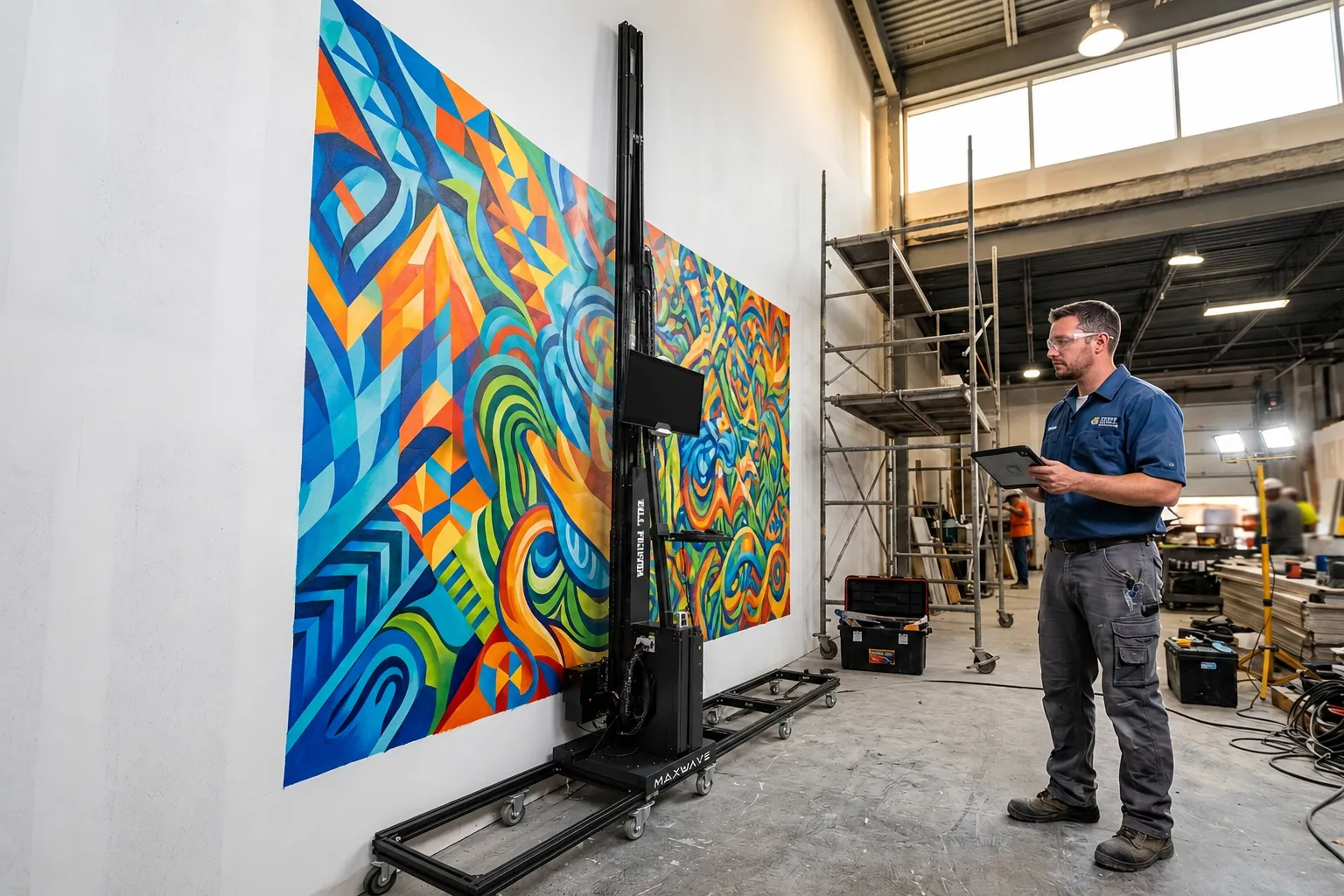
Financing Options and Cash Flow Optimization
A $58,555 machine doesn't have to hit your bank account all at once — and for most wall printing startups, it shouldn't.
Wallpen's published financing example breaks it down clearly: $58,555 financed over 36 months at 5% comes to $1,708/month. That's the number from the earlier sections. But 36 months is aggressive. Stretch to 60 months on a $50,000–$65,000 unit, and your monthly obligation drops by hundreds of dollars. Your cash flow picture changes with it.
What Financing Costs You Per Month
At 6% APR over 60 months on a $50,000 machine financed at 100%, your monthly payment comes to $966. That's less than the 36-month Wallpen example — with two extra years of runway.
Here's how the rate sensitivity plays out on that same structure:
APR | Monthly Payment (60-month, $50k) |
|---|---|
4% | ~$921 |
6% | ~$966 |
8% | ~$1,014 |
10% | ~$1,062 |
12% | ~$1,112 |
The spread from 4% to 12% is $191/month. On a $6,000/month gross margin baseline, that difference is about a 1.6–3.2 percentage point swing in net margin. Meaningful — but not deal-breaking if your pipeline is solid.
A useful rule of thumb: every 2 percentage points of APR change shifts your monthly payment by $45–$50 on a 5-year, 100%-financed $50k machine. Use that number to pressure-test rate quotes before you sign.
Loan vs. Lease-to-Own: Which Structure Fits Your Stage
Your financing structure isn't just about rate. It's about where you are in the business lifecycle.
Equipment loan (ownership path):
- Fixed monthly payments; you own the machine outright at term end
- Qualifies for Section 179 expensing in the U.S. — you can deduct the full purchase price in Year 1, even while spreading payments over 5 years
- Banks and SBA programs often require 10–20% down, but specialized equipment lenders regularly offer 100% financing with no down payment for qualified borrowers
- SBA 7(a) loans for equipment run 7.5–11.5% interest with up to 10-year terms; SBA 504 loans offer 6–8% fixed rates for major machinery
Lease-to-own (capital lease):
- Lower early-year payments; the structure works more like OpEx than CapEx
- Useful for conserving cash during the revenue ramp-up period
- Higher total cost of ownership if there's a balloon buyout at the end
- You get less access to strong depreciation benefits compared to an outright loan
The bottom line: with tax capacity and stable cash flow, a conventional equipment loan with Section 179 front-loading tends to win on lifetime cost. Launching lean and watching every dollar of working capital? A lease-to-own structure buys you time.
The Cash You Preserve Matters as Much as the Cash You Spend
Here's what most buyers miss: paying cash for the machine isn't the smart move by default.
Financing 100% of the equipment cost keeps your liquidity free for three things that shape whether the business survives its first year:
Ink and consumable buffer — keep at least 1–3 months of expected ink usage in stock. Job interruptions from supply gaps cost you in reputation, not just dollars.
Spare parts reserve — set aside 5–10% of equipment value for heads, belts, sensors, and emergency service. That's $2,500–$5,000 sitting liquid and ready.
Launch marketing runway — allocate 3–6 months of ad spend from cash, not debt. You can adjust spend without touching loan covenants.
A drained bank account after a cash purchase leaves you exposed at the worst possible time — before the machine is generating steady revenue.
Before You Sign: The Risk Checkpoints
Don't commit to a 5-year obligation without running these numbers first:
1. Pipeline test. Before the equipment arrives, have signed or near-certain contracts covering at least 3–6 months of loan payments in gross margin. On a ~$1,000/month payment, that means $3,000–$6,000 in contracted contribution margin queued and ready.
2. Contingency reserve. Hold 10–15% of your total cost of ownership in liquid reserves. On a $60,000 TCO (machine + first-year costs), that's $6,000–$9,000 split across emergency repairs, downtime coverage, and demand shortfalls.
3. Rate shock stress test. Your loan may be variable or SBA-linked. Model a +300 basis point rate increase. Confirm your debt-service coverage ratio stays at or above 1.25x. If it falls short, renegotiate terms or build a larger cash buffer before closing.
The machine payment is predictable. The real risk isn't the payment — it's signing before your revenue pipeline can support it.
Conclusion
The numbers don't lie — and now, neither does your decision.
You came here asking whether Wallpen is worth the money. The honest answer: it depends on how you run the math for your situation. A full-time wall printing entrepreneur recouping investment in under 8 months? That's a very different story from someone printing two murals a month as a side project.
This Wallpen price guide makes one thing clear — the machine cost is just the opening chapter. Your real edge comes from knowing the full wallpen operating cost per square meter. That means ink, maintenance, software, and your own time — all of it — before you sign anything.
So here's your next move:
Pull the ROI models from this guide
Plug in your local market rates
Run your own numbers
Payback period lands under 12 months? You already have your answer.
The wall is a blank canvas. The question is whether you'll be the one printing on it.
If Wallpen feels beyond your current stage, explore mid-tier and entry-level alternatives first — the right wall printer is the one that matches your budget, volume, and business stage, not just the highest specification.