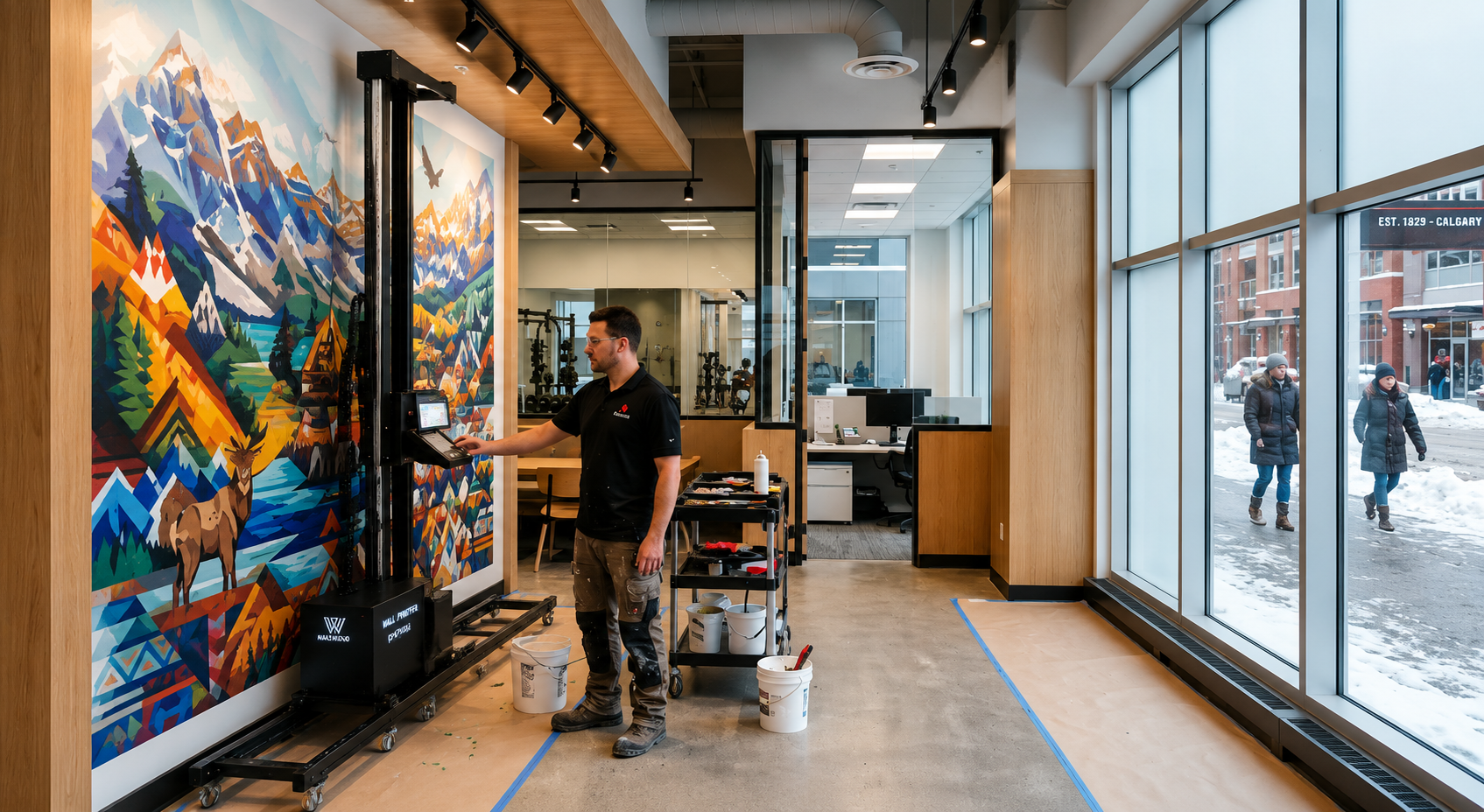
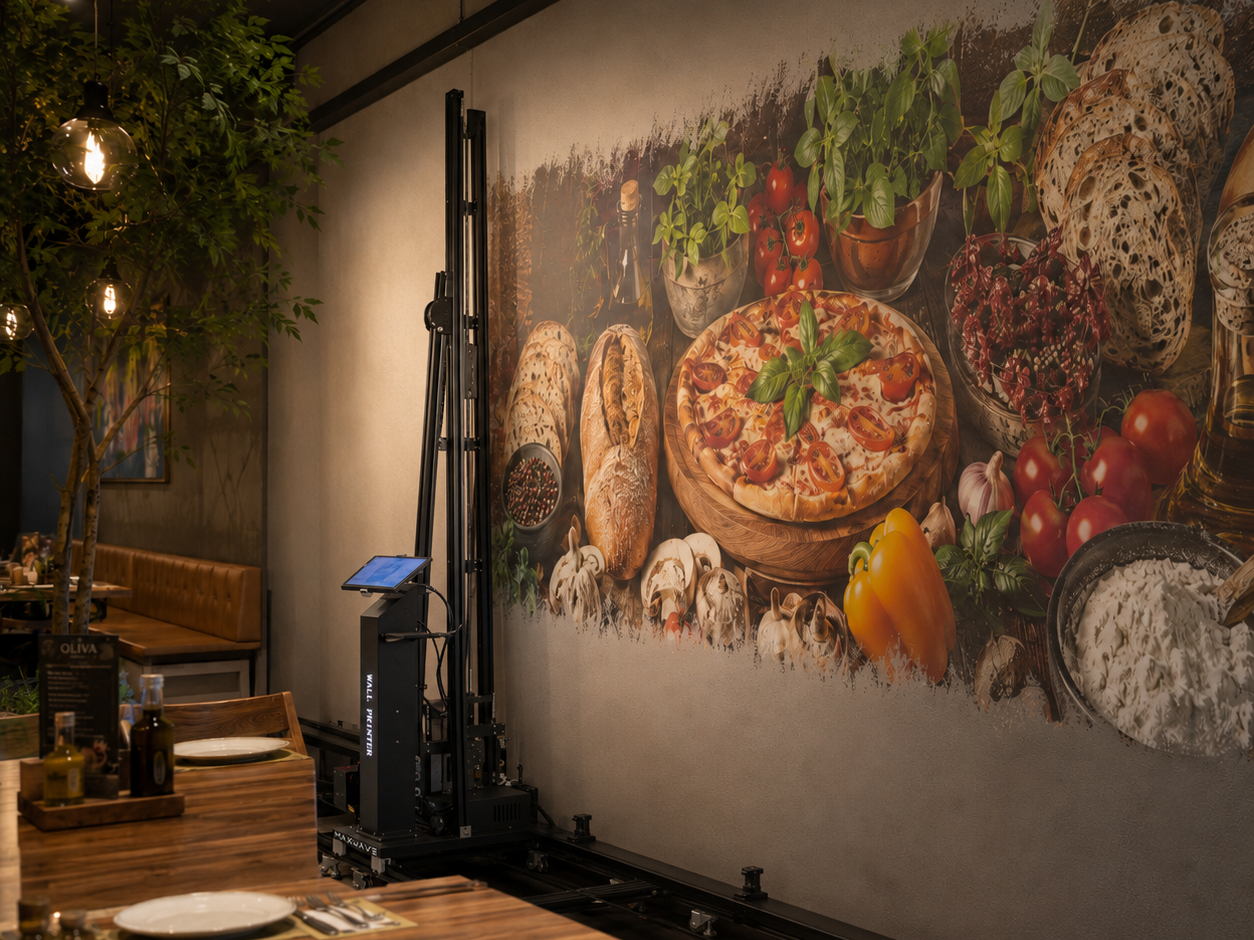
You've seen the demos. A robot glides across a blank wall. Within minutes, a stunning mural appears from nothing. Maybe you pulled out your phone and filmed it. Maybe you've already Googled "how to start a wall printing business" three times this week.
But there's a gap between that spark of excitement and writing a check. One question keeps stopping you cold: how much money does this take? Not a range. Not a vague estimate. Real numbers.
Your total startup investment could land anywhere between $8,000 and $100,000+. The final number depends on choices you haven't thought to consider yet — hidden costs like ink consumables, liability insurance, vehicle rigging, and six months of operating runway. Nobody puts those in the brochure.
This guide breaks down every dollar of your vertical wall printer cost and startup budget across three distinct investment tiers. You'll walk away with a concrete go/no-go decision — not more questions.
Direct-to-Wall Equipment Acquisition & Vertical Printer Cost Breakdown
The machine is your single largest investment. This one decision shapes every financial number that follows.
Hardware alone spans $3,000 to $60,000+. But the sticker price is a trap. Add freight, customs, spare printheads, software licensing, and on-site commissioning — your true "ready-to-print" cost lands 30–60% above whatever a manufacturer quotes you. Here's how to budget each tier.
Tier 1: Entry-Level Vertical Wall Printer ($4,000–$7,500 All-In)
Chinese OEM machines list between $2,800 and $6,000 EXW on Alibaba. These are single or dual Epson DX7/XP600-class heads, manual leveling, basic water-based or eco-solvent ink. That's your starting point — not your ending point.
Add these unavoidable costs on top:
Export crating + inland freight (China origin): $150–$400
Ocean/air freight + customs + brokerage: $300–$1,000
Initial ink set + cleaning fluids: $150–$300
Basic spare parts (dampers, capping station, nozzle plates): $100–$300
Realistic delivered budget: $4,000–$7,500. A $3,500 machine becomes a $5,500–$6,500 machine before you print a single square foot.
Tier 2: Mid-Range UV Wall Printer ($10,000–$24,000 All-In)
This is where the UV wall printer investment gets serious. UV-curable systems come with Ricoh or industrial Epson heads, integrated RIP software, auto-leveling sensors, and rigid commercial frames. Hardware runs $8,000–$20,000 — lower if you buy direct from Asia, higher through a US/EU distributor with local support.
The meaningful cost upgrades at this tier:
UV printhead upgrade (vs. entry water-based): +$1,500–$4,000
Integrated RIP software license: $600–$2,000 built into the price
On-site installation + operator training: $500–$1,500
First-year preventive maintenance parts kit: $200–$600
Realistic all-in budget: $10,000–$24,000. This tier gets you outdoor-durable prints, faster speeds, and clients ready to pay commercial rates.
Tier 3: Premium US/EU-Assembled System ($35,000–$70,000 All-In)
Premium 3D wall printing machine platforms — built or assembled in North America and Europe — start at $29,995 for base configs and go past $60,000+ for multi-head, extended-height versions. You're paying for CE/UL compliance, closed-loop precision motion, 3.5–4m+ print height, and warranty coverage worth $2,000–$6,000 in service value.
Spare printhead inventory (2 heads recommended): $2,400–$5,000
Wall-alignment + distortion-correction software add-ons: $300–$1,500
Shipping + factory calibration + on-site commissioning: $500–$2,000+
Realistic all-in budget: $35,000–$70,000. Resale value stays high. Breakdowns are far less frequent. Over a 4–6 year ownership window, the total cost of ownership math works out better than that sticker price implies.
The Number Every Buyer Misses: Spare Printheads
Budget for spare heads no matter which tier you choose. Industrial UV heads — Ricoh Gen series, Epson i3200-U — run $1,200–$2,500 each. A professional operation needs one to two spares on hand. That means setting aside $2,000–$5,000 before your first paying job. A clogged head on a live commercial job site is a revenue-killing emergency. It's not a routine maintenance issue you can schedule around.
Mandatory Overheads: Wall Printing Business License Requirements & Insurance Compliance
Most first-time wall printing entrepreneurs budget zero dollars here. That mistake costs them $500 to $3,500 before printing a single wall.
Compliance isn't optional. It's the foundation your entire wall printing service pricing model sits on. Split your costs into four areas: entity formation, licenses/permits, insurance, and workspace safety.
Entity & Permits: $200–$1,000
LLC state filing fee: $50–$500 (varies by state)
DBA/trade name registration: $10–$150
Municipal business license: $50–$300
Zoning clearance for your workspace: $50–$250
Home occupation permit (garage operations): $25–$200
Fire department inspection/permit: $50–$300
Insurance: $400–$3,500/year
Commercial clients — hotels, restaurants, schools — will ask for proof of $1M general liability before you touch their walls. Budget $400–$1,500/year for that policy alone. Also plan for inland marine coverage for your UV wall printer ($300–$1,200/year). Add commercial auto coverage if you run a dedicated van ($800–$2,000/year).
Bottom line: Set aside $800–$2,500 upfront for compliance costs. This step is not optional — skip it and you risk fines, canceled contracts, or losing clients before your business gets off the ground.
Initial Inventory & Consumable Budget Planning
Here's a number most wall printing guides skip: $1,850 to $3,900 — spent before you land your first client. This has nothing to do with your machine cost. That's your consumable reality check.
Your printer is useless without ink. Your ink is useless without primers, masking tape, and cleaning solutions. And your jobs are at risk without a small but critical stash of spare parts. Every dollar in this category decides whether your first 90 days feel like a real business — or a very expensive hobby.
Ink & Coatings: $500–$1,200
Ink is your single most variable ongoing cost. How you stock it at launch shapes your margins from day one.
Here's the math that matters:
1 liter of ink covers 400–800 sq ft of wall (lower for heavy photographic murals, higher for lighter designs and text)
Target 3,000–5,000 sq ft of output in your first month. That means you need 6–9 liters across CMYK channels — with a 20% safety buffer built in
Three real stocking scenarios:
Strategy | Ink Type | Volume | Cost | Coverage |
|---|---|---|---|---|
Budget starter | 3rd-party eco-solvent @ $80/L | 8L | $640 | ~4,800–6,400 sq ft |
Mixed approach | OEM CMYK + 3rd-party white | 7L blended | $940 | ~4,200–5,600 sq ft |
Full OEM UV | Branded UV @ $180/L | 6L | $1,080 | ~3,600–4,800 sq ft |
Protective topcoats belong in your standard workflow — especially for commercial clients. Add $90–$150 for a gallon of UV clear or liquid laminate. One gallon covers about 1,000–1,500 sq ft per application.
Recommended starting ink budget: $500–$1,200, based on your ink strategy and projected first-month volume.
Maintenance & Site Prep Consumables: $150–$400
These are the unglamorous $30 line items that quietly eat your margins. Skip the planning, and they'll catch up with you fast.
Printer maintenance essentials:
- OEM cleaning solution (1–2L): $25–$80
- Flush cartridges (2–4 units): $30–$140
- Lint-free wipes (bulk pack 200–500 pcs): $15–$40
- Nitrile gloves, swabs, syringes, funnels: $28–$55
On-site preparation supplies:
- Painter's tape, multi-width (6–10 rolls): $30–$70
- Roller frames, covers, trays, extension poles: $40–$90
- Drop cloths — canvas + disposable plastic: $20–$60
- Surface degreaser, detergent, microfiber cloths: $25–$50
A lean starter kit runs about $170–$260. A fuller setup — enough buffer stock to handle multiple back-to-back jobs without an emergency supply run — lands at $230–$380.
Critical Spare Parts Reserve: $400–$800
Don't try to stock every possible component. Focus on the parts that stop your production cold.
Your "must-not-fail" minimum kit:
Encoder strip: $60–$150
Encoder sensor: $80–$180
Timing belt + tensioner assembly: $70–$210
Secondary carriage/feed motor: $120–$250
Key PCB or interface board: $180–$350
A practical low-downtime set — encoder strip, encoder sensor, one timing belt, one motor — comes in around $520. A tighter $400 version covers the encoder components, a belt, fuses, and holds ~$100 for fast shipping on a deadline break. A fuller $780 kit adds a PCB module and gives you real backup coverage.
Planning range: $400–$800. The split between physical stock and cash reserve depends on your supplier's lead times. Sourcing from overseas? Buy physical parts. Have a local distributor? A cash reserve works just as well.
Software & Digital Assets: $800–$1,500 (Year 1 Cash Impact)
This category catches almost every new wall printing operator off guard. The software stack isn't optional. It's what separates professional output from amateur results.
Three realistic setups:
Lean stack (~$860/year):
- Adobe Creative Cloud (1 user): ~$720/year
- Wall template pack: $80
- Texture/pattern bundle: $60
Enhanced stack (~$1,450/year):
- Adobe CC: ~$720
- RIP software contingency: $400
- Templates + mockups: $150
- Stock photo subscription (6 months): $180
Perpetual license alternative (~$880 upfront, lower recurring):
- Affinity Designer/Photo/Publisher suite: ~$180 one-time
- RIP software: ~$500
- Templates + asset bundles: ~$200
Many OEM printers include basic RIP software. Verify this before purchase. No bundle? Set aside a $300–$600 contingency — a missing RIP license is a day-one production stopper.
Your Total Consumable Budget at a Glance
Category | Low-End | High-End |
|---|---|---|
Ink & coatings | $500 | $1,200 |
Maintenance & site prep | $150 | $400 |
Critical spare parts | $400 | $800 |
Software & digital assets (year 1) | $800 | $1,500 |
Total | $1,850 | $3,900 |
This entire budget sits apart from your machine, insurance, and vehicle costs. Most new operators underfund this category. Then they scramble to cover it after their first job deposit clears.
Budget it upfront. You'll run a cleaner operation from day one.
Logistics, Vehicle Setup & Marketing Launch Reserve
Your machine is sitting in the garage. Now what? Moving it to a job site costs real money. So does getting clients to know you exist. Most startup budgets skip both line items entirely.
Vehicle Setup: Two Paths, Two Very Different Price Tags
Option A: Use your existing SUV ($300–$850)
Most bootstrapped operators start here. It's the smart move.
Cargo organizers, straps, moving blankets: $150–$300
Magnetic door signs or vinyl decals: $100–$400
Dash tablet mount + 12V inverter: $50–$150
Option B: Buy a used cargo van ($8,500–$21,500)
A Ford Transit or NV200 with 100k–180k miles runs $8,000–$20,000 on CarGurus. Then add:
Title, registration, inspection: $300–$800
Interior racking and anti-slip flooring: $500–$1,500
Commercial auto insurance: $150–$350/month
Start with your SUV. Switch to a van once steady revenue supports the extra cost.
Marketing Launch Budget ($1,050–$4,600)
Item | Low | High |
|---|---|---|
Domain + hosting (year 1) | $50 | $200 |
Website template + branding | $200 | $600 |
Google Ads + local SEO (Q1) | $500 | $3,000 |
Wall graphic sample prints | $80 | $250 |
QR case-study cards | $80 | $200 |
Banner stand + table throw | $150 | $350 |
Total | $1,060 | $4,600 |
Physical samples close deals faster than any website. Set aside $310–$800 for printed proof materials. Have them ready before your first sales conversation.
6-Month Operating Reserve: $9,000–$18,000
This number makes or breaks your wall printing business model. Here's what a solo operator burns each month:
Fuel + tolls: $290–$590/month
Maintenance reserve: $80–$200/month
Phone + SaaS tools: $100–$300/month
That's $1,500–$3,000 per month. Multiply by six. You need $9,000–$18,000 in liquid reserves sitting in your account before you print your first commercial wall.
Tier 1: Low-Budget Starter Case ($8,000–$15,000)
Eight thousand dollars. That's all that stands between you and your first paying wall printing job.
This tier fits the solo operator. You work evenings and weekends. You store gear in a garage. You drive to every job site yourself. No employees. No studio rent. No overhead bloat. Just you, a machine, and a local radius of 10–20 miles.
Here's where every dollar goes:
Category | Mid-Case Cost | Notes |
|---|---|---|
Machine + accessories | $4,500 | Entry-level system, basic accessories included |
Consumables & spares (3–6 mo.) | $700 | Ink, tape, rollers, nozzles, replacement parts |
Registration + insurance | $400 | Business registration, basic general liability |
Marketing + test ads | $500 | Website, branding, Meta/Google local ad tests |
Workspace | $0 | Client site work only; home storage |
Cash buffer | $2,000 | Fuel, repairs, slow months, contingencies |
Total | $8,100 |
At the upper end (~$15,000), your machine jumps to $6,000–$7,000. Consumable stock grows to $1,500. Your marketing budget hits $1,500 — covering professional photography and stronger local ads.
Who's Buying at This Price Point
Forget hotels and corporate lobbies. Your Tier 1 clients are:
Residential homeowners wanting nursery murals, home office accent walls, and living room features — 40–80 sq ft per project
Small cafes and salons needing one branded feature wall with simple typography or logo work
Airbnb hosts and rental landlords adding a single statement wall to boost listing photos
These clients pick you over premium mural studios for two reasons: lower price and faster turnaround. One day per wall, start to finish. That's your edge.
The Revenue Math — Run It Yourself
Part-time hours — evenings and weekends. Here's what the numbers look like:
Projects per month: 6–10
Average project size: 40–80 sq ft
Pricing structure: $150–$200 call-out fee + $6–$10 per sq ft
Average ticket: $350–$500 per job
Once your pipeline fills, you're pulling in $3,000–$5,000 in gross revenue per month. Running costs — insurance, fuel, software, ongoing ads — sit at $800–$1,200 per month. After all cash costs, net profit lands at $1,500–$2,500/month once you're past the ramp-up phase.
Payback Timeline: 14–18 Months
The first 3–6 months are slow. You're building reviews and referrals. Net surplus during this phase runs $500–$800/month. By month seven, repeat business and word-of-mouth kick in. That figure climbs to $1,200–$2,000/month.
The math on getting your $8,000–$15,000 back:
At $800/month average net → 10–19 months
At $1,200/month average net → 7–13 months
Blended realistic timeline: 14–18 months for a part-time solo operator
One rule worth protecting: keep at least 25% of your total startup budget as an untouched cash buffer. Most Tier 1 operators don't fail because a machine breaks or clients vanish. They fail because they put every dollar into equipment and had nothing left when the first slow month hit.
Tier 2: Standard Commercial Configuration Case ($30,000–$60,000)
Thirty thousand dollars buys you a real business — not a side hustle.
At this investment level, you're done chasing homeowners for $400 accent walls. You walk into regional restaurant chains, commercial real estate firms, and corporate lobbies. You have a professional pitch. You have the equipment to back it up. This is where wall art printing becomes a scalable commercial wall printer ROI story.
Here's where the money goes:
Category | Low | High | Notes |
|---|---|---|---|
Production machine | $14,000 | $30,000 | 54–64" UV/eco-solvent or UV flatbed, entry commercial grade |
Consumables & spares | $1,500 | $4,000 | Inks, media, spare heads, cleaning kits |
Software + insurance | $1,200 | $4,000 | RIP license, liability, inland marine coverage |
Vehicle + tools | $6,000 | $12,000 | Used cargo van, ladders, drills, levels, PPE |
Marketing launch | $3,000 | $6,000 | Website, SEO, sample kits, paid campaigns |
6-month cash buffer | $8,000 | $15,000 | Rent, fuel, owner draw, insurance during ramp-up |
Total | $33,700 | $71,000 | Trim top-end items to stay inside $60k |
To hit the $30k–$60k sweet spot, keep your machine at $14k–$20k. Cap the van at $6k–$8k — a 10–12 year-old cargo van does this job well. Don't overspend on marketing or inventory upfront. That's where most people burn cash early.
Your Target Client Mix
Drop the idea of walk-in retail volume. Tier 2 runs on fewer, larger B2B accounts with repeat work:
Commercial real estate staging — wall prints, window graphics, directional signs. Plan on 1–3 projects per month per client
Regional restaurant groups — seasonal promo kits, menu boards, wall murals. The real money comes from standardized "new promo pack" orders across 10+ locations
Retail brand rollouts — POP displays, multi-location window sets, hanging signs with strong repeat potential
Corporate lobby graphics — feature walls, frosted glass film, reception logos. Lower frequency, higher margin, strong referral value
Build 3–5 anchor accounts across these categories. That focus — not raw volume — is what keeps this tier stable and profitable.
The Revenue Numbers, Broken Down
By months 4–6, you're running 12–20 projects per month, averaging 100–250 sq ft each. Blended wall printing service pricing at this level lands at $6–$10 per sq ft, mixing print-only and print-plus-install jobs.
Conservative math at 16 projects per month:
Gross revenue: $8,000–$13,000/month
Fixed OPEX (facility, utilities, insurance, vehicle, software): $2,500–$3,500/month
Variable COGS at 25–40% of revenue: ~$3,360 at midpoint
Pre-owner-comp operating margin: ~$4,140/month
Payback Timeline: 10–14 Months
A $40,000–$50,000 total investment with $3,500–$5,000/month in cash flow puts full capital recovery at 10–14 months under normal execution. Push to 20 projects per month. Lock in bulk ink discounts — that cuts COGS by 5–10 percentage points. Tighten your routing between client sites. Do all three and the timeline drops to 10–12 months.
The math works only if you stay full-time and sales-focused from month one.
Tier 3: High-End Brand & Franchise Operation Case ($60,000–$100,000+)

At $74,000 invested, you stop selling walls. You start selling contracts.
This is the tier where hotels call you — not the other way around. Multi-wall resort packages. Hospitality procurement teams. Interior designers with six-figure renovation budgets who need architectural wall art on repeat. The wall printing franchise cost at this level puts you at a different table — a much bigger one.
Here's where the money goes:
Category | Cost | Notes |
|---|---|---|
Premium machine / franchise fee | $38,000 | Commercial-grade UV system or branded franchise entry |
Consumables & spares | $2,500 | Ink, spare heads, maintenance kits |
Insurance & compliance | $2,000 | Full commercial liability + inland marine |
Dedicated cargo fleet | $15,000 | Multi-crew capable van setup |
Multi-channel marketing | $6,500 | SEO, proposals, B2B outreach |
6-month cash buffer | $10,000 | Covers delayed collections and onboarding lag |
Total | $74,000 |
What Your Revenue Model Really Looks Like
Forget retail volume. Tier 3 runs on 20–35+ projects per month, averaging 150–400 sq ft each. Most of these are multi-wall packages inside a single commercial property.
The numbers at steady state:
Gross revenue: $15,000–$25,000+/month
Fixed OPEX (including one technician): $5,000–$7,000/month
Implied payback window: 8–10 months
That payback timeline beats both Tier 1 and Tier 2. Here's why: commercial wall printer ROI grows with ticket size, not transaction volume. One hotel corridor job can bring in what a Tier 1 operator earns in six weeks.
The Scale Lever Nobody Talks About
You don't need a second machine to double output. You need a second crew. Hire one trained technician — not new hardware. That's what opens the door to multi-state commercial contracts at this tier. Your machine costs stay fixed. Your revenue ceiling goes up.
Franchise Buyers: Do This Before You Sign Anything
Going through a branded wall printing franchise instead of going independent? The FTC Franchise Rule gives you specific rights. Use them.
Demand the Franchise Disclosure Document. Go through initial fees, territory terms, royalty structure, marketing restrictions, and required equipment — line by line.
Get earnings claim proof in writing. The FTC took action against Jani-King for a clear reason — franchisors have been caught pushing income projections with no data behind them. Don't take anyone's word for it verbally.
Call existing franchisees. The FDD includes their contact details. Ask them straight — does this system support commercial B2B sales? Your whole revenue model depends on contract-based project flow, not residential walk-ins.
The indoor wall printing technology investment at this tier is solid. The franchise structure around it still needs your own verification before you commit.
Unit Economics: Wall Printer Ink Cost Per Sq Ft & Service Pricing Strategy
Here's a number worth knowing: ink costs as little as $0.05 to $0.40 per square foot to print. Your client pays $20. That spread is your business model.
Take a concrete example. A 40 sq ft mural uses 100 ml of ink at $0.16/ml — that's $16 in total ink cost. The same job billed at $20/sq ft brings in $800 in revenue. Set aside labor and travel for a moment. The gross margins you're left with beat what most service businesses ever see.
What Your Real Cost Stack Looks Like
Ink alone doesn't tell the full story. Here's your total loaded cost benchmark per square foot:
Ink + coatings: $1.00–$3.00/sq ft
Labor + wall prep: variable, but price based on working time
Travel allocation + vehicle wear: route-dependent
Equipment wear (printhead reserve): set aside $60–$80/month for head replacement, plus ~$280/year in other consumable parts
Realistic loaded operating cost: $1.50–$2.80/sq ft. Against a $20+ sale price, that's a 65%–80%+ gross margin. You get there by booking jobs in tight routes and sending clean, optimized files to print.
Pricing by Market Segment
Stop guessing. Use these verified benchmarks:
Segment | Market Rate |
|---|---|
Residential | $10–$25/sq ft |
Commercial / Corporate | $15–$25/sq ft |
Premium / Textured / Complex | $25–$50/sq ft |
One operator's hard floor: $20/sq ft minimum, with a 5×8 ft mural at $800 flat. A corporate 100 sq ft job at $25/sq ft brought in $2,500 in revenue against $30 in UV ink cost.
Five Tactics That Protect Your Margin
Cluster jobs by location. Book jobs in the same area on the same day. Drive time is your biggest hidden cost — cut it hard.
Charge more for difficult conditions. Textured walls, high ceilings, tight access, heavy coverage — each one adds cost. Price accordingly.
Set minimum order thresholds. A 15 sq ft job eats setup time that a 150 sq ft job doesn't. Protect your hours.
Bundle design and install. Sell the finished wall, not the ink. Package pricing moves the conversation away from per-sq-ft math.
Clean up files before printing. Strip out heavy solid fills. Less ink, faster print, better margin.
The math is simple: ink cost is almost never the problem. What eats your returns is weak pricing and poor scheduling. Lock those two down, and the numbers work the way they should.
12–18 Month Break-Even Timeline & Cash Flow Projection
The numbers don't lie — and here's the one that matters most: month 5 is where the bleeding stops.
That's not optimism. That's math. Here's a clear breakdown of how cash flows in, how it flows out, and where the two lines cross.
Your Fixed Cost Baseline (The Floor You're Working Against)
Before a single client calls, you're burning $6,300–$6,500 every month. Here's where it goes:
Owner draw: $3,000
Van, rent, insurance, utilities: $1,500
Software, phone, web tools: $300
Marketing baseline: $700
Machine loan payment (if financed): $800–$1,000
That's your enemy. Every month, that number wakes up hungry. Your job is to outrun it.
The break-even formula is simple:
Monthly break-even jobs = Fixed costs ÷ (Job price − variable cost per job)
Plugging in real Tier 2 numbers — $6,500 fixed costs, $650 average job, $130 variable cost per job:
$6,500 ÷ ($650 − $130) = 12.5 → 13 jobs/month
Thirteen jobs. That's your monthly target. Every job before that number is a loss. Every job after it builds toward payback.
Phase 1: Months 1–3 (The Bleeding Phase)
Nobody likes to talk about this part. But it's real, and you need to plan for it.
You won't hit 13 jobs in month one. You'll hit 2. Maybe 4 by month two. Here's what the real numbers look like:
Month | Jobs | Avg Price | Revenue | Contribution | Fixed Costs | Net |
|---|---|---|---|---|---|---|
1 | 2 | $450 | $900 | $640 | $6,500 | −$5,860 |
2 | 4 | $525 | $2,100 | $1,580 | $6,500 | −$4,920 |
3 | 8 | $600 | $4,800 | $3,760 | $6,500 | −$2,740 |
Cumulative 3-month deficit: ~$13,500.
That number is not a failure. That number is the reason you build a cash reserve before you start. Your first-month pricing should be discounted — 20–30% off for your first 10–15 clients. That discount builds your portfolio and pulls in reviews. Those reviews close every job that comes after.
Your marketing spend also spikes during this phase — $1,000–$1,500/month. That covers Google Business Profile work, social proof content, and introductory local ads. That's not waste. That's pipeline construction.
Phase 2: Months 4–6 (Break-Even Crossing)
Referrals kick in. Early clients reorder. Your pricing moves back toward full rate.
Month | Jobs | Avg Price | Contribution | Fixed Costs | Net |
|---|---|---|---|---|---|
4 | 11 | $625 | $5,995 | $6,500 | −$505 |
5 | 14 | $650 | $7,280 | $6,500 | +$780 |
6 | 17 | $650 | $8,840 | $6,500 | +$2,340 |
Month 5 is your break-even month. Not approximate — specific. Fourteen jobs at $650 average with 20% variable costs crosses the line into operating profit.
By month 6, you're generating $2,340 in monthly operating profit. That's real money working to recover your initial investment. The cumulative $13,500 deficit from Phase 1 is about 50% recovered by month 7.
Phase 3: Months 7–12 (Scale & Recovery)
Solo capacity tops out at around 22 jobs/month — about one job per working day with a small buffer. At 80%+ utilization, you're running 18–20 jobs per month at a steady pace.
Here's what month 9 looks like at that rate:
20 jobs @ $675 average
Revenue: $13,500
Variable costs: $2,600
Contribution: $10,900
Fixed costs: $6,500
Operating profit: $4,400 (33% net margin)
That 30–33% margin is your target zone. It means the business is healthy. It means you can absorb a slow week without panic.
Full capital recovery timeline by tier:
Tier | Monthly Profit (Months 7–10) | Break-Even Month | Full Payback |
|---|---|---|---|
Tier 1 ($8k–$15k) | $1,200–$2,000 | Month 5–6 | 14–18 months |
Tier 2 ($30k–$60k) | $3,000–$5,000 | Month 4–5 | 10–14 months |
Tier 3 ($60k–$100k+) | $5,000–$6,500 | Month 3–4 | 8–10 months |
The Hire Trigger: When to Add a Second Crew
Don't hire based on gut feel. All three conditions below need to be true before you pull the trigger:
≥18 jobs/month for 3–4 consecutive months
Net margin at 30% or above — held steady, not just a one-month spike
Closing cash balance covers at least 3 months of added payroll
One technician adds $4,300–$5,300/month in total cost — salary, taxes, benefits, and an incremental vehicle. Your capacity jumps to 40+ jobs. At 28 jobs post-hire — a conservative 65% utilization — here's what you're generating:
Revenue: $19,600
Operating profit: $4,660
Net margin: ~24% (climbs as utilization grows)
That margin dip is temporary. It's the cost of building a scalable business instead of staying a one-person ceiling on your own income.
The Reinvestment Checkpoint
Track one final number across your entire 18-month window: cumulative operating profit vs. machine purchase price.
Once cumulative profit passes your original machine cost, the machine has paid for itself. Every dollar earned after that point goes toward your second unit — or your first hired crew.
For a Tier 2 operator, that crossover lands around month 10–12. For Tier 3, aggressive pricing and a faster ramp can push it to month 8.
That's the point where this stops being a startup and starts being a business.
Conclusion
The numbers don't lie — and now, you don't have to guess either.
Working with $10,000 or $100,000, the wall printing business rewards one thing above all else: financial clarity before your first print job. You now have the full cost map that most aspiring operators never see. That includes equipment tiers, hidden overheads, ink economics, and a realistic 12–18 month break-even timeline — built around your budget level, not someone else's highlight reel.
Here's the truth about UV wall printer investment: the machine is just the entry fee. Your real competitive advantage is knowing where every dollar goes before you spend it.
So here's your next move:
Pick the tier that matches your current capital
Build your 6-month cash flow projection using the numbers in this guide
Request equipment quotes from at least three suppliers this week
The wall is waiting. The question left is: are you ready to print your first dollar?