Starting a wall printing business sounds exciting. Then you check the "startup cost guides" online—and they hand you a range so wide ($5,000 to $50,000) it tells you nothing useful for a real financial decision.
Before you swipe your card on a vertical wall printer or lock in a commercial wall printer setup, you deserve actual numbers. What does each line item cost? What does it cost you per wall? How long before this thing pays for itself?
This breakdown answers all of that. You get a dollar-level teardown of every cost module—from wall mural printer machine cost to ink, insurance, and the sneaky expenses nobody warns you about. Plus, there are three budget-tiered starter plans and a 12-month cash flow model you can plug your own numbers into.
Equipment Investment: Commercial Wall Printer Cost & Tier Comparison
The machine is the business. Everything else—your van, your Instagram ads, your business cards—is scaffolding. So let's talk about what a commercial wall printer costs, and what those dollars buy you.
Wall printing equipment breaks into three distinct tiers. These aren't arbitrary marketing categories. They reflect real, functional differences that decide whether you're profitable in year one or struggling into year two.
The Three Tiers: What Your Money Gets You
Tier 1 — Entry-Level: $3,000–$8,000
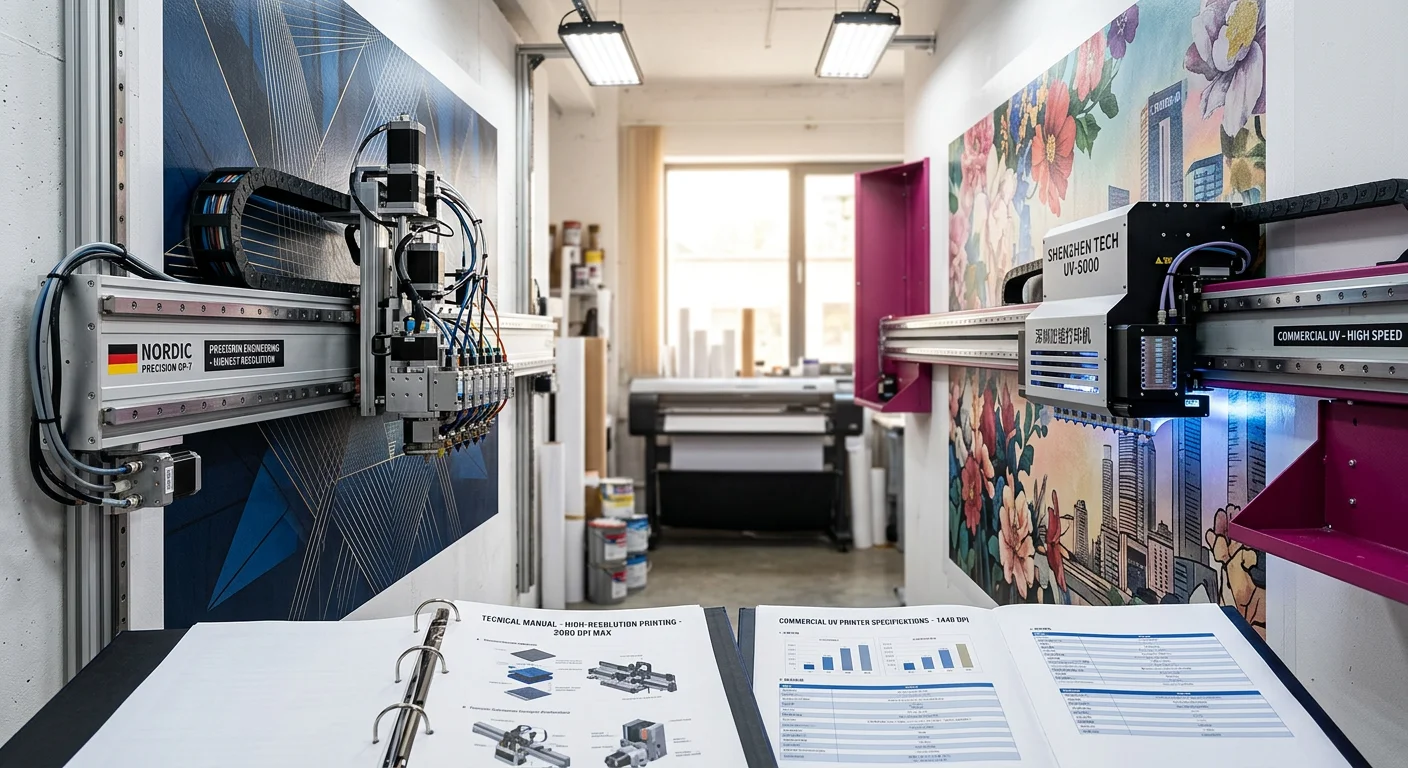
These are single-printhead machines out of Shenzhen or Jinan factories. Basic motion rails, minimal positioning software, solvent or eco-solvent ink systems. They work—on flat, indoor walls, with patient operators, for small local jobs.
What they won't handle: uneven surfaces, large-scale murals, or a client who expects hotel-lobby precision. Failure rates are higher. Downtime costs you jobs, not just money.
Tier 2 — Mid-Range: $8,000–$30,000
This is where serious wall printing businesses start. Brands like Friankor, DXONJET, and Tudox sit in this range. You get dual-head UV systems, auto-leveling rails, rack-and-pinion motion, and bundled tiling software that handles color registration well.
Ink costs drop sharply at this level. The Friankor MK-01 uses 6–10 ml per m², which works out to $0.50/m² in ink cost—plus $1–$3/m² for pre/post coating. That's your real UV wall printer operating cost per job at this tier.
Tier 3 — Premium: $30,000–$60,000+
The Wall Printer (USA) starts at $29,995. Wallpen (Germany) sits in the same premium band. Both offer industrial motion control, proprietary software, and advanced curvature compensation. Wallpen prints a 3×3 ft panel in 33 minutes. The DXONJET takes 75 minutes for the same job. That 2.5× speed gap matters on large hotel or school projects.
Operating costs are higher, too. The Wall Printer's ink runs $0.16/ml. That means 100 ml covers just 40 ft², putting ink cost around $4.30/m². Add Wallpen's pro software subscription at $2,700/year, and total ownership costs climb fast.
The Quick Comparison
Tier | Machine Cost | Key Hardware | Ink Cost/m² |
|---|---|---|---|
Entry | $3,000–$8,000 | Single head, basic rails | Higher; limited published data |
Mid-Range | $8,000–$30,000 | Dual-head UV, auto-leveling | ~$0.50 (+ $1–$3 coating) |
Premium | $30,000–$60,000+ | Multi-head, industrial control | ~$4.30 (The Wall Printer) |
Where to Spend—and Where to Save
Never cut corners on: the printhead class, control board, and motion system. Cheap rails on an uneven wall don't just produce bad prints—they produce bad reviews. Moving from a $4,000 clone to a $9,000 mid-tier machine is often the line between a hobby and a real business.
Safe to save on: the metal shell, cosmetic housing, and the bundled computer. Bring your own laptop instead of paying for a built-in screen. That alone saves you several hundred dollars.
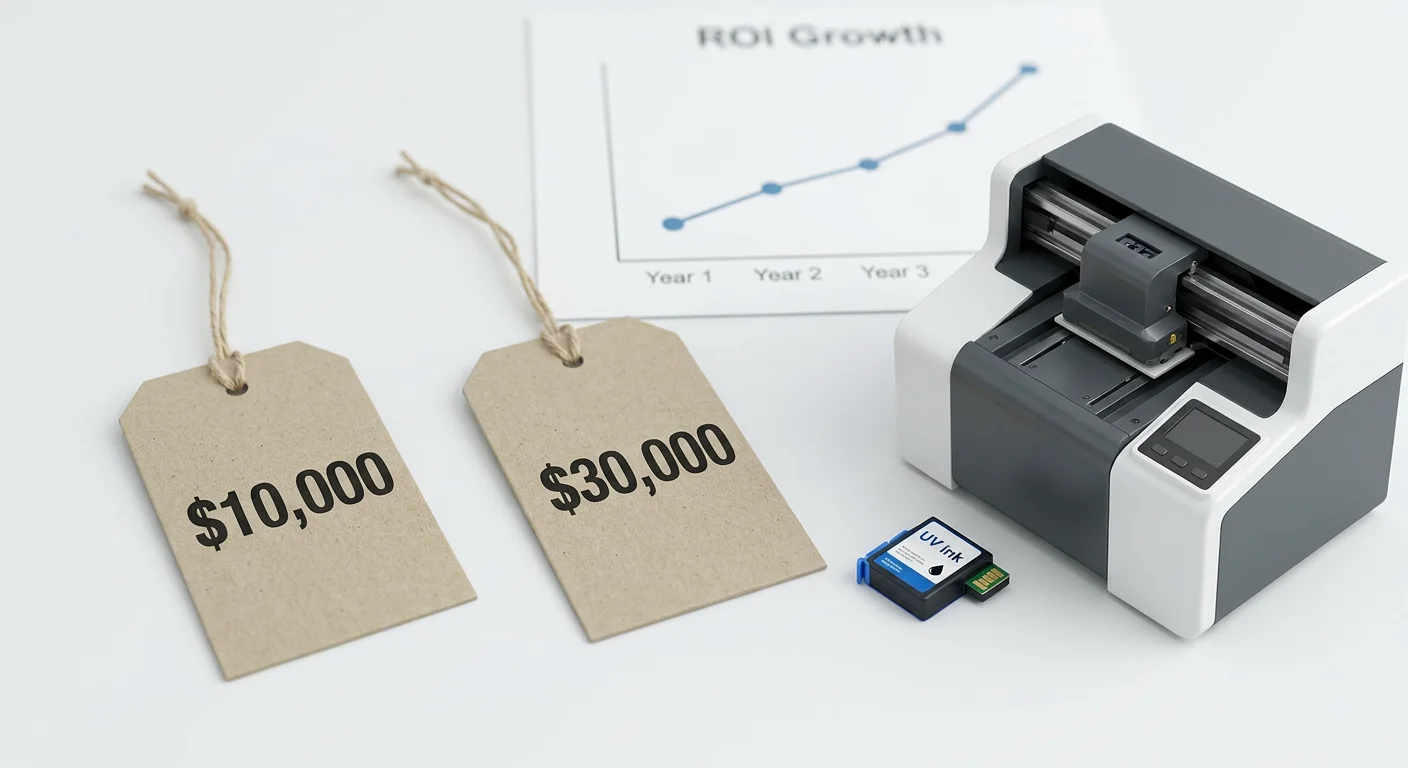
One more thing worth saying directly: Western franchise packages marketed with "earn $1,000/day" promises are priced for that story, not just the hardware. A proven mid-tier Chinese UV wall printing machine at $10,000 can deliver faster ROI on small-to-medium jobs than a $30,000 franchise starter kit—so run the numbers before you commit.
Initial Consumables & Wall Printer Ink Cost per Square Meter Breakdown
Initial Consumables & Wall Printer Ink Cost per Square Meter Breakdown
Ink is the cost that eats your margin when you're not paying attention.
It doesn't show up on your invoice as one big number. It bleeds out milliliter by milliliter, job by job. Before you know it, you've been underquoting for three months. So before you print a single wall, know what consumables cost to stock—and what they cost you per square meter on the job.
Your First Consumables Order: Three Budget Tiers
How much you spend upfront on ink and supplies depends on how fast you're launching:
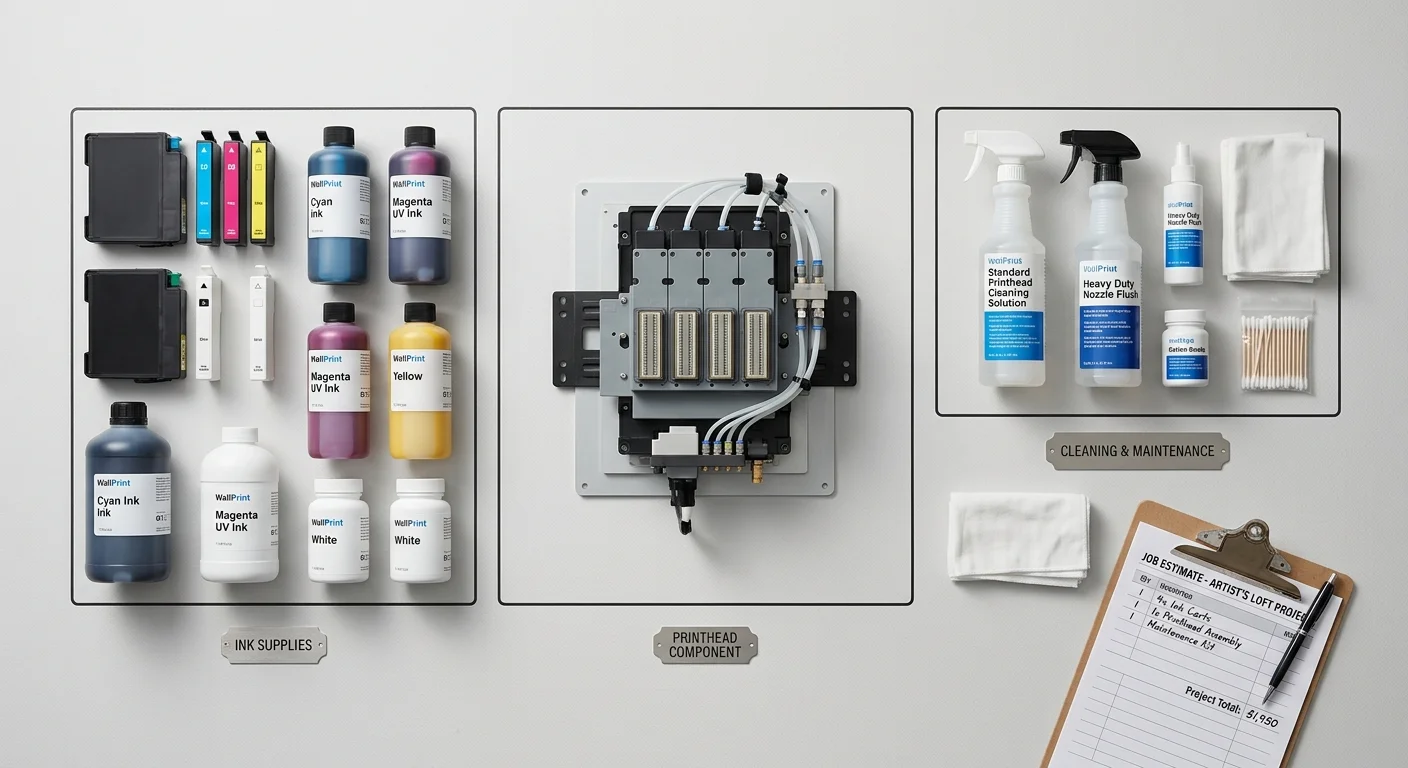
Entry Starter Pack ($300–$600): 4-color basic ink set (~4L) + 1 spare printhead + standard cleaning solution. Covers 30–50 m² of test jobs. Good for validating your first few clients before scaling.
Standard Starter Pack ($1,000–$1,800): 6–8 color industrial ink set + 2 spare printheads + dedicated flush solution and line maintenance kit. This covers 100–150 m² of production capacity. That's enough to handle your first serious pipeline of work.
Premium Starter Pack ($2,500–$4,000): Bulk OEM specialty inks including white ink, gloss varnish, and fluorescent colors + a full consumables inventory. This tier is built for high-margin commercial projects. Clients at this level are paying for premium finish.
The Ink Cost Math You Need
Here's the number that matters: UV ink costs vary by system, but for WallPrintBox-class systems, ink is typically around $50/L, or $0.05/ml.
At a stable consumption rate of around 8 ml/m², your ink cost lands at approximately: $0.40/m²
That makes it one of the most cost-efficient consumable structures in the wall printing category.
WallPrintBox operating cost advantage: significantly lower ink-per-square-meter cost improves margin flexibility and shortens ROI cycle compared to higher-consumption systems.
For comparison, most UV wall printing systems in the market sit at:
$0.50–$1.00/m² for standard jobs
Up to $3–$5/m² for full coverage, coating-heavy murals
A real example: a 40 sq ft wall uses around 100 ml of ink. That costs about $5 in ink at this system level. Scale that up—a 100 m² mural burns roughly 800 ml. Your ink-only cost lands around $40.
The rule that keeps your quotes honest: ink should take up no more than 5–7% of your total project price. Charging $1,000 for a wall? Your ink spend shouldn't go past $50–$70. Past that point, your pricing structure—not your workflow—needs adjustment.
Budgeting for Wear Parts Beyond Ink
Ink is the biggest consumable line item. It's not the only one.
Printhead replacement reserve: Set aside $50–$80/month. A printhead holds up for about one year under normal use. Annual replacement cost depends on usage, but should always be budgeted separately from ink.
Other wear parts (cleaning kits, maintenance supplies): Plan for $200–$400/year based on operational intensity.
Think of consumable costs as three separate line items: ink + printhead depreciation + cleaning/maintenance supplies. Run every job estimate through all three. Don't just check the ink bottle.
Operational Prep: Vehicles, Licenses, Insurance & Workspace Setup
Most first-time wall printing entrepreneurs obsess over the machine. They forget that getting the machine to the job—on time, road-legal, and in one piece—is its own cost center.
Here's how the operational setup math breaks down across three budget levels.
Budget Tier 1: The Lean Launch ($500–$1,200)
No van needed on day one. Your existing SUV or pickup does the job—with one non-negotiable upgrade: vibration dampening.
Industry data puts transport-related equipment failures at 30–50% of early-stage breakdowns. Printhead clogs, cracked solder joints, loose connectors—most trace back to road vibration, not operator error. A welded steel bracket with rubber isolation pads runs $150–$300 in materials and labor. Add fasteners and tie-down hardware for another $30–$80. That's your protection against a ruined printhead before you've printed a single paying wall.
For workspace, a home garage or a friend's spare storage bay works fine. Plan to spend $180–$350 on basic shelving and a moisture-resistant cabinet.
Insurance at this stage means one thing: tell your insurer that the vehicle now has commercial use. A liability rider adds $150–$400/year to your premium. Don't skip this step. One client property claim without proper coverage shuts down the business faster than any equipment failure ever could.
Lean Launch Total: $500–$1,200
Budget Tier 2: The Serious Setup ($3,000–$6,000)
At this level, you're renting or leasing a used panel van—interior height of at least 1.8 m, payload capacity of 1,000 kg or more. Rent runs $450–$800/month, with one to two months upfront as a deposit.
The van needs a proper anti-vibration cabinet system: a 19-inch rack with shock-mounted rails, elastic suspension hardware, and aviation-track floor anchors. Budget $800–$1,500 for the full install. That sounds steep—until you look up the price of a replacement printhead.
Licensing at this tier is simple:
A service business operating license costs $50–$200 in most areas
Tax registration is free or close to it
Set aside $200–$400 for extra compliance fees—stamp duties, publication requirements, and the small administrative costs that always pop up
For insurance, get a Commercial General Liability (CGL) policy at $1M per-occurrence and $2M aggregate. That's the baseline for any operator working in schools, hospitals, or commercial properties. Annual premiums for small service businesses run $400–$1,200. Also hold back a $500–$1,000 compliance reserve for surprises.
Serious Setup Total: $3,000–$6,000
Budget Tier 3: The Full Build ($10,000–$90,000+)
This tier fits operators running crews, pitching hotels, or building a training and franchise operation. The core vehicle is a custom-outfitted box truck—aluminum frame interior, dedicated equipment bays, and an onboard power system that delivers 3–5 kW continuous output with a 5–10 kWh battery bank for off-grid jobs. The vehicle with custom buildout alone runs $35,000–$68,000.
From there, add:
A pure sine wave inverter with UPS stabilization ($2,000–$4,000)
An onboard workstation with ventilation and industrial Wi-Fi ($1,300–$3,800)
At that point, you're operating a mobile production facility—not just a delivery vehicle.
Insurance scales up to match. Equipment floater coverage (also called inland marine) on a $50,000–$150,000 equipment inventory costs 1–3% of asset value per year—that's $500 to $4,500 annually. Add employer's liability and workers' comp for a small crew at $600–$2,000/year.
Need a demo space or training room? Budget $300–$1,000/month in rent for a 150–400 sq ft workspace. Fitting it out with display hardware and a demo wall adds another $2,000–$6,000.
Full Build Total: $45,000–$90,000
The One Rule That Saves You Thousands Early On
Don't sign a street-front retail lease in year one. A high-visibility storefront costs $2,000–$8,000/month—five to ten times more than a back-office or shared workspace. In the first 6–12 months, your job pipeline won't cover it. Run mobile and appointment-based instead. Put the savings into marketing or a second machine. The storefront can come later—once clients are finding you, not the other way around.
Marketing & Customer Acquisition for Wall Printing Business Startup
Most service businesses don’t fail because of poor quality work.
They fail because the market never sees the work.
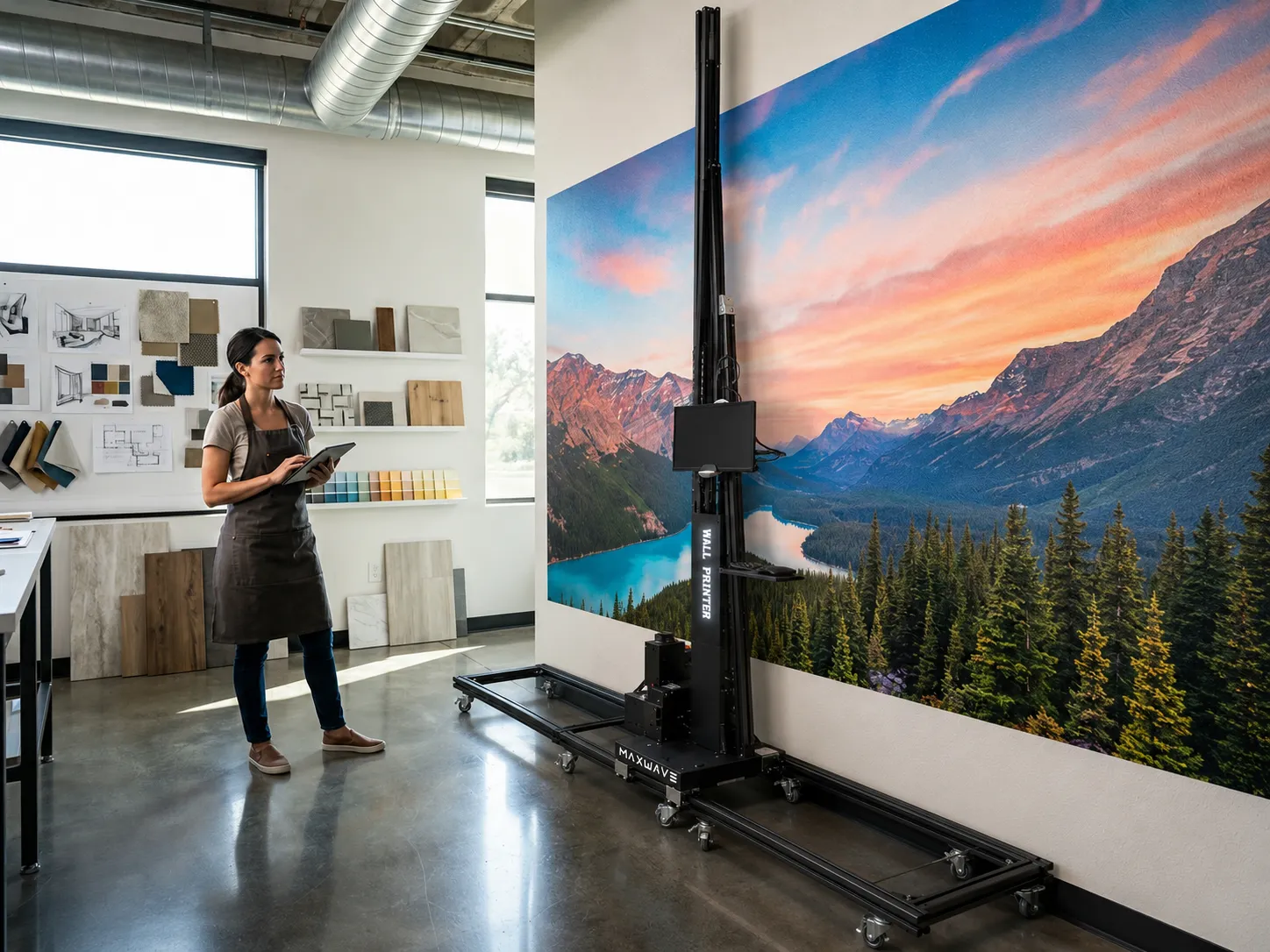
Wall printing is highly visual, which makes marketing both the challenge and the advantage. The goal is simple: turn real printed walls into your main sales engine.
Tier 1: Lean Launch ($200–$500/month)
In the early stage, the fastest growth does not come from ads — it comes from visibility.
The most effective move is offering a few free or low-cost demo walls to local businesses such as cafés, gyms, or salons. These locations are not chosen randomly. They are designed to generate strong visuals and real customer foot traffic, which naturally turns into content.
Each completed wall becomes a marketing asset. Photos, time-lapses, and short videos are reused across social platforms like TikTok, Instagram Reels, and YouTube Shorts. Over time, consistent posting builds local awareness far more effectively than paid ads alone.
Setting up a Google Business Profile early is critical. Once real project photos and reviews are collected, it becomes a steady source of inbound leads without ongoing cost pressure.
At this stage, the goal is not scale — it is proof of work. Most operators begin seeing consistent inquiries once 3–5 demo projects are published online.
Tier 2: Standard Setup ($800–$1,500/month)
Once visibility is established, the strategy shifts from awareness to intent capture.
Google Ads targeting local search queries becomes the core channel. Users searching for wall printing or mural services already have purchase intent, which leads to higher conversion rates compared to social traffic.
At the same time, referral partnerships become a major growth driver. Interior designers, contractors, architects, and real estate professionals already control access to wall projects. With a simple commission structure, they often become a predictable monthly pipeline.
Supporting materials still matter. Brochures and portable sample panels help convert interest into trust, especially in B2B environments where decisions are not made instantly.
Growth at this stage comes from combining search traffic + referrals + direct sales conversations into one system.
Tier 3: Full Scale ($2,500–$5,000/month)
At higher budgets, marketing becomes system-driven, not campaign-driven.
Trade shows and live printing demonstrations become key lead sources because buyers can see the machine working in real time.
Digital expansion moves into LinkedIn Ads and YouTube campaigns, targeting decision-makers like facility managers, developers, and procurement teams.
At the same time, reseller partnerships in other cities or regions extend reach without increasing operational workload.
Content production becomes structured, shifting from simple clips to professional case studies and long-form project videos, used across ads and sales presentations.
At this level, marketing is no longer about visibility — it is about controlling distribution channels.
Core Principles Across All Stages
Across all budget levels, three things stay consistent:
The strongest marketing asset is always real printed walls in real spaces. Whether it is a café, gym, or retail store, physical results convert far better than digital visuals.
Second, high-intent search traffic consistently outperforms broad advertising. People already searching for wall printing services are much closer to buying.
Finally, referrals compound over time. Once designers, contractors, and realtors enter your network, they become the most stable long-term source of projects.
12-Month Outcome Benchmark
After one year, a stable operation typically has:
A portfolio of 10–20 completed projects
20–40 Google reviews
5–10 active referral partners
At this point, inbound demand becomes more predictable and pricing power increases.
The key shift is simple: marketing stops being effort-based and becomes asset-based.
Key Insight
Wall printing businesses do not scale through ads alone. They scale through visible work that sells the next job automatically.
Training, Learning & Wall Printer Software Investment
Most guides ignore this: your machine is only as good as the operator.
Training and software are not optional—they protect your $10,000–$70,000 investment and determine early job quality.
What You Need to Spend
Lean Launch ($0–$300): Most learning is already included: manuals, setup videos, calibration guides, plus free user groups for real-world troubleshooting.
Free tools like GIMP, Inkscape, Krita handle basic file prep. A small online course ($20–$80) is usually enough.
Goal: get clean, stable output—not perfection.
Standard Setup ($1,000–$2,000): This is structured onboarding: 3–5 days of training covering calibration, RIP software, surface prep, and troubleshooting ($500–$1,200 if not included).
Most users also upgrade to Adobe/CorelDRAW for better file control.
Goal: consistent commercial output.
Full Build ($3,500–$6,000): Advanced training covers color profiles, multi-panel alignment, and maintenance for high-end projects.
Many operators also invest in better PCs and calibrated displays for color accuracy.
Goal: production-level quality control.
The Rule That Saves Money
Do not overbuy software.
Most machines already include RIP functions like scaling and tiling. Only add tools if they solve a real production gap.
Keep extra software spend under $1,000 initially.
Final Insight
Maintenance skills matter more than design tools.
If you can fix calibration errors and maintain the printhead, you already outperform most beginners.
Most operators recover training costs within 3–12 months, often before the machine itself is fully paid off.
Single Project Pricing & Wall Printing Service Profit Margin Formula
Here's the number that makes wall printing worth doing: a well-run project carries a 40–70%+ gross margin. That's not a typo. It's not a best-case scenario either. You get these numbers by pricing with a clear strategy and keeping an honest eye on your costs.
The formula has four moving parts. Master them once. Every quote you build from here gets faster and more accurate.
Your True Cost Per Square Meter
Every project cost breaks down into four components:
Unit Cost/m² = Equipment Depreciation + Ink & Consumables + Labor + Transport/Setup
Equipment depreciation: Take your monthly machine cost. Divide it by the square meters you print that month. A $15,000 printer depreciated over 5 years at moderate utilization adds roughly $8–$15/m² to your cost base.
Ink and consumables: Target 8–15% of your selling price per m². At $150/m², that's $12–$22 in consumables. Stay inside that band and your margins stay healthy.
Labor: Figure $20–$35/hour for on-site work. A 20 m² job tends to run 10–14 hours across setup, printing, and cleanup.
Transport and overhead: Fuel, parking, travel time. On a standard local job, budget $50–$150 total—then spread it across the project area.
What to Charge: The Pricing Structure
Standard indoor walls run $100–$300/m², based on your market and positioning. Outdoor jobs, curved surfaces, or high-altitude work? Add a 1.5–2.0× complexity multiplier. No need to justify it. Those conditions cost you real time and real materials.
For bigger or multi-room projects, use a tiered structure. Charge full rate on the first 20–30 m², then offer a 5–25% discount on extra square footage. Your transport cost spreads across a larger job. Margins go up, not down.
Two worked examples:
Residential (20 m²) | Commercial (50 m²) | |
|---|---|---|
Rate | $120/m² | $150/m² |
Project Price | $2,400 | $7,500 |
Total Cost | ~$700 | ~$1,640 |
Gross Margin | ~71% | ~78% |
Three Rules That Protect Your Margin
Wall prep is not your problem—unless you bill for it as a separate line item. Patching, priming, and skim coating go on their own invoice or on the client's contractor list. Surface prep that bleeds into your "printing cost" breaks the margin formula fast.
Premium services carry premium rates. Rush jobs, night work, extended design revisions—price these at $35–$50+/hour or a flat premium. These jobs often carry higher margins than the base print itself.
Watch the ink ratio every month. Consumables creeping past 15% of revenue per square meter? Your pricing needs an adjustment. Your workflow does not.
The formula is straightforward. The real work is using it on every single job. That discipline is what separates operators who can't figure out where their margin went from the ones who always know exactly where it stands.
6-Month & 12-Month Breakeven Timeline & Cash Flow Model
Numbers without a timeline mean nothing. Here’s the real cash flow path.
Baseline: a $12,000 startup setup including machine, initial ink, sample production, and basic marketing.
Months 1–3: Setup Phase (Negative Cash Flow)
You will lose money first. That’s normal.
Fixed monthly cost: $2,500–$3,800
Job volume: 0–2 jobs/month
Average profit per job: $700–$800
Cash flow:
Month 1: ≈ -$800 (setup, calibration, first outreach)
Month 2: ≈ -$500 (1 small pilot job)
Month 3: ≈ -$300 (1–2 jobs, early pipeline forming)
Goal of this phase is not profit — it is building 3–5 real project samples (before/after cases).
6-Month Breakeven: 10–12 Jobs Total
Average job value: $1,200
Gross margin: 60–70% ($700–$840 per job)
Break-even point: 10–12 jobs total
Typical ramp:
Month | Jobs | Total Jobs |
|---|---|---|
1 | 0 | 0 |
2 | 1 | 1 |
3 | 2 | 3 |
4 | 2 | 5 |
5 | 3 | 8 |
6 | 3–4 | 11–12 ✓ |
Key milestone: 1.5–2 jobs/month from Month 4 onward
At this point, cash flow turns neutral to positive.
Months 7–12: Profit Phase
Now the business starts compounding.
Target: 6–8 jobs/month
Client types:
Interior designers
Renovation contractors
Restaurants & cafés
Gyms, schools, retail chains
Monthly Profit Estimate
Volume | Revenue | Gross Profit | Fixed Costs | Net Profit |
|---|---|---|---|---|
6 jobs | $7,200 | ~$4,700 | $3,000–$4,500 | $1,000–$2,000 |
8 jobs | $9,600 | ~$6,200 | $3,000–$4,500 | $3,000–$5,000 |
At 8 jobs/month, monthly profit stabilizes at $3K–$5K
Year 1 total profit (second half): $18K–$30K range
Warning Sign (Very Important)
If you stay below 2 jobs/month for 5 months, the model breaks:
Revenue < $2,400/month
Fixed cost > revenue
Monthly loss: -$600 to -$1,500
This is the signal to fix:
marketing
partnerships
outreach pipeline
Not the machine.
Top 5 Hidden Cost Pits & Money-Saving Strategies
Your budget always looks correct—until real jobs start.
Then reality adds costs slowly, not all at once. The problem is not one big mistake. It’s five small ones stacking together until margins disappear.
Pit 1: Buying Too Much Equipment Too Early
Many buyers overbuy at the start—$35K–$50K “complete systems” when a $8K–$15K machine can already handle most commercial wall printing jobs.
The real issue is leverage.
A $10K setup can break even in just a handful of jobs, while a $50K system needs far more volume before it pays itself back.
The principle is simple: equipment should stay within 30–40% of your startup capital, so cash is still available for marketing, materials, and growth.
Pit 2: Hidden Printhead Cost
Printheads feel like a one-time purchase, but they are actually a predictable monthly cost spread over time.
Each unit costs roughly €800–€1,200 and lasts 12–18 months under normal usage.
That means every month, you are already “spending” around $60–$80—even if nothing breaks.
The mistake most operators make is not tracking this at all, until a sudden failure removes a full month of profit.
Treat it like rent, not repair. Set aside a fixed monthly reserve and protect it with proper cleaning and certified ink.
Pit 3: Underpricing the Real Job Scope
A wall job is never just printing.
The printed surface might be 20 m², but the real work includes travel, setup, calibration, height adjustment, and dealing with imperfect surfaces.
If you only charge for square meters, you end up absorbing all operational time for free.
A healthier model separates pricing into:
base printing, site access, and complexity adjustments—so difficult walls actually pay more.
Pit 4: Franchise Math That Doesn’t Scale
Franchise models often look attractive on paper: high income projections, structured systems, and ready-made branding.
But the cost structure is less visible:
royalties, required consumables, and supplier lock-in.
Over time, these reduce margin and limit flexibility.
Independent ownership usually wins because every job retains full profit control, without percentage cuts or supply restrictions.
Pit 5: Renting Space Too Early
A storefront feels like progress—but in year one, it rarely drives customers.
Most wall printing demand comes from:
referrals, online visibility, and direct outreach—not walk-in traffic.
A fixed shop adds pressure before revenue is stable.
In early stages, mobility matters more than location. The machine goes to the wall—not the other way around.
Final Insight
Hidden costs are rarely dramatic. They are repetitive:
overbuying equipment
ignoring maintenance
underpricing work
following franchise assumptions
renting too early
Fix those five decisions, and most profitability issues disappear before they start.
Conclusion
You came here with a number in your head and a question mark in your gut. Both probably look a little different now.
Here's what this entire breakdown comes down to: wall printing is not a "maybe someday" business — it's a math problem. Run the math, and the numbers lean in your favor. A mid-tier vertical wall printer in the $6,000–$9,000 range can hit breakeven before Month 10. That's with disciplined project pricing and lean overhead. That's not a pitch — that's the wall printing equipment investment model you just watched get built, line by line.
The hidden costs are real. But so is the margin.
Now comes your part. Pull the numbers from your own situation — your city, your vehicle, your network — and plug them in. The spreadsheet logic is already in your hands.
One question remains: are you ready to put your number in it?