A wall printer can be a profitable investment—but only when there is enough real demand to keep it working.
The machine itself is not the business.
You still need customers, suitable wall-printing applications, pricing that leaves enough margin, reliable equipment, and enough cash to cover shipping, ink, maintenance, marketing, and occasional downtime.
For an established decoration company, sign shop, mural business, or interior contractor with an existing customer base, a wall printer can create a valuable new service line.
For someone starting from zero with no leads or sales plan, the same machine can sit idle for months.
So, is a wall printer worth it?
Yes, when you can generate enough profitable wall-printing jobs to recover the complete startup cost within a reasonable period. No, when the purchase is based mainly on the expectation that customers will appear after the machine arrives.
Is a Wall Printer Worth It at a Glance?
Buyer Situation | Worth It? | Why |
|---|---|---|
Existing décor or printing company | Usually yes | Existing customers can be converted into mural projects |
Sign shop adding wall printing | Usually yes | Natural extension of existing commercial printing services |
Interior contractor or mural business | Often yes | Can add custom graphics without outsourcing |
Solo entrepreneur with validated local demand | Possibly | Lower overhead, but sales volume must be proven |
New buyer with no customers yet | High risk | Equipment may sit idle while marketing costs continue |
Buyer attracted mainly by “fast ROI” claims | Usually no | Revenue depends on sales, not machine capability alone |
The most important factor is not how impressive the printer looks in a demonstration.
It is how many profitable jobs you can realistically sell each month.
What Does a Wall Printer Really Cost?
The purchase price is only the beginning.
A buyer should calculate the complete ready-to-operate investment, not simply the price shown on a supplier quotation.
Depending on the wall prinitng machine and delivery terms, the startup budget may include the printer, freight, import costs, starter ink, cleaning solution, software, spare parts, computer equipment, training, transportation cases, and marketing.
Operating the machine also creates ongoing costs.
UV ink and white ink are consumed with every project. Printheads, pumps, filters, sensors, wipers, and other components eventually need maintenance or replacement. If the operator is an employee rather than the owner, labor must also be included.
Downtime matters as well.
A printer that stops during a commercial project does not only create a repair expense. It can also delay the job, require a second site visit, or damage the relationship with the customer.
This is why the cheapest machine is not automatically the cheapest business investment.
A better buying question is: What will this system cost when it is delivered, working, supported, and ready to complete paid jobs?
Machine Price vs. Total Startup Cost
A simple startup budget should include:
Cost | What to Include |
|---|---|
Equipment | Wall printer and selected configuration |
Delivery | Freight, customs, taxes and local delivery |
Consumables | CMYK ink, white ink and cleaning fluid |
Software | RIP and machine-control licenses |
Spare parts | Basic maintenance and critical replacement parts |
Training | Setup, calibration, artwork and maintenance |
Marketing | Website, samples, ads and local customer acquisition |
This is a more useful figure for ROI calculations than the machine price alone.
Is There Enough Demand for Wall Printing?
Demand exists, but not every market is equally valuable.
The strongest opportunities usually come from customers who already spend money on interior decoration, branding, renovation, murals, signage, and custom environments.
Residential customers may order children's room murals, feature walls, family spaces, or decorative artwork.
Commercial customers may need branded office walls, reception graphics, restaurant interiors, retail displays, hotel decoration, gyms, schools, and entertainment spaces.
The difference is that commercial projects can be larger and may create repeat business.
One restaurant mural may lead to another location. A retail project can become a multi-store rollout. An interior-design company can bring several projects per year.
That repeatability matters more than broad claims about the size of the wall-art market.
A wall printer becomes more attractive when your customer acquisition strategy can produce recurring commercial or referral-driven projects rather than isolated one-off jobs.
Demand Matters More Than Printing Speed
A machine that can print several square meters per hour does not automatically generate several square meters of paid work every hour.
Many new buyers focus heavily on printing speed because it is easy to compare on a specification sheet.
But the real bottleneck for a new wall-printing business is often sales.
A printer may complete a residential mural in several hours and then remain unused for the rest of the week.
That is why order volume should be estimated before equipment capacity.
Start by estimating how many realistic projects you can sell each month.
Then estimate the average revenue from each project and subtract the direct costs required to complete it.
Only after that should you decide how much machine capacity you need.
Buy capacity for the business you can realistically build—not for a production volume you hope to reach someday.
How to Calculate Whether a Wall Printer Will Pay Back
You do not need a complicated financial model.
The most useful calculation is the payback period:
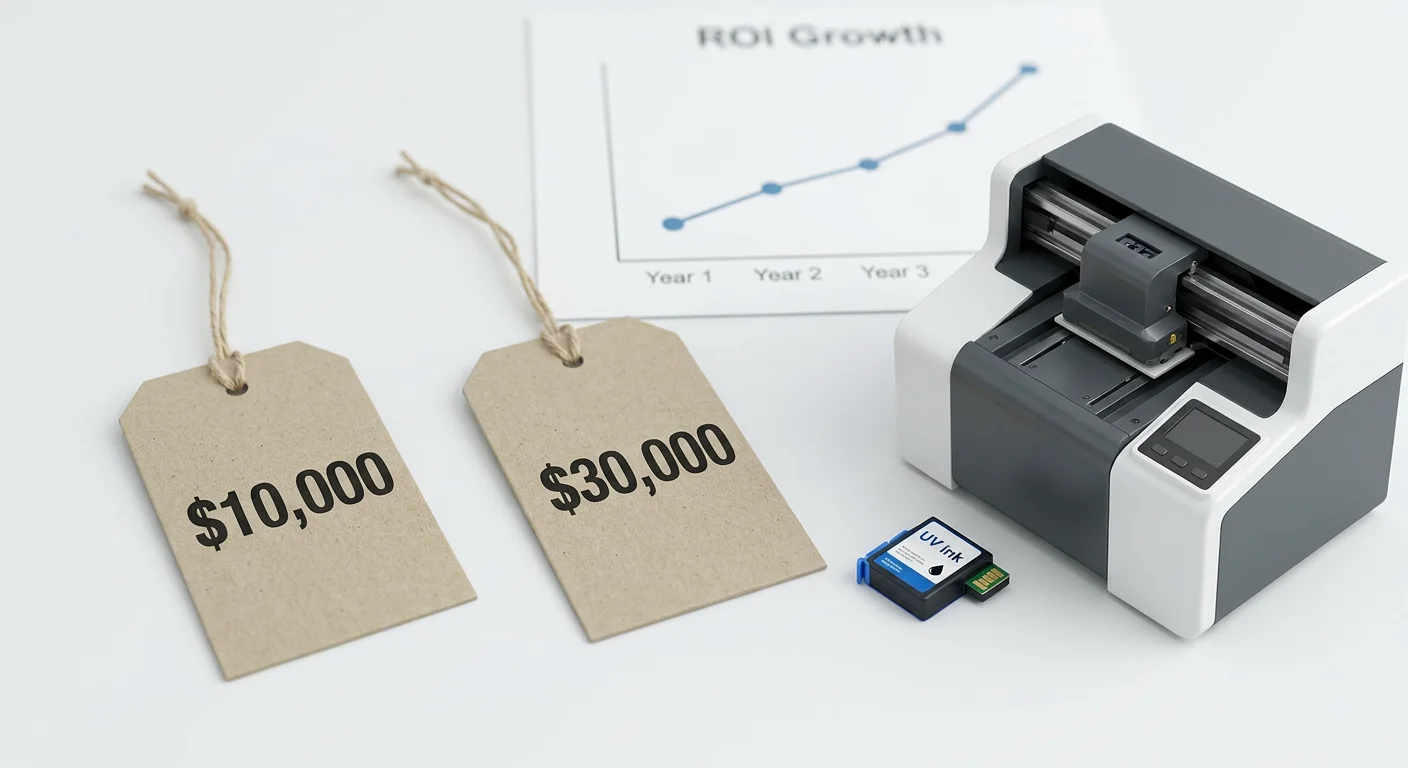
Payback Period = Total Startup Investment ÷ Monthly Net Profit From Wall Printing
Monthly net profit should not mean sales revenue.
It should be the amount remaining after direct operating costs such as ink, travel, labor, surface preparation, commissions, maintenance reserve, and marketing.
For example, imagine the complete startup investment is $8,000.
If wall-printing projects generate $2,500 per month in additional revenue but $1,300 is spent on labor, ink, travel, marketing, and other operating costs, the real monthly contribution is $1,200.
The payback period would therefore be roughly:
$8,000 ÷ $1,200 = 6.7 months
But if the business only generates $400 of real monthly profit, the same investment takes 20 months to recover.
The printer has not changed.
The customer pipeline has.
This is why universal claims such as “payback in three months” should be treated carefully.
A supplier can estimate machine productivity, but it cannot guarantee your local sales volume.
Which Buyers Are Most Likely to Make a Wall Printer Worth It?
Existing Decoration, Signage or Printing Businesses
These are some of the strongest candidates.
They already have customers purchasing visual decoration, signage, graphics, renovation, or branded environments.
Wall printing becomes an additional service rather than a completely new business.
Customer acquisition costs are therefore lower, and the company can cross-sell murals to clients it already serves.
For these businesses, a wall printer can reduce outsourcing while expanding the range of projects they can accept.
Interior Designers and Contractors
Interior professionals may also be a strong fit because wall printing can become part of a larger renovation or design package.
Instead of selling a standalone mural, the business can combine custom wall graphics with furniture, lighting, flooring, signage, or interior construction.
This creates a much stronger sales proposition than trying to sell wall printing as an isolated novelty.
Solo Entrepreneurs With Validated Demand
A solo operator can run a successful wall-printing business because staffing and overhead can remain relatively low.
But validation is important.
Before purchasing equipment, the buyer should understand:
Who will buy the service;
What competitors charge;
Which projects are easiest to sell;
How customers will be acquired;
How much each job can realistically contribute.
A new entrepreneur who already has leads, local partnerships, or booked projects is in a much stronger position than someone purchasing first and planning to market later.
Buyers With No Sales Pipeline
This is the highest-risk group.
A technically excellent wall printer does not solve a customer-acquisition problem.
If there is no website, portfolio, contractor network, local advertising strategy, commercial outreach, or existing client base, the machine may spend far more time parked than printing.
That does not mean a new business cannot succeed.
It means sales validation should happen before the largest equipment investment.
When Is a Wall Printer Not Worth It?
A wall printer is usually a poor investment when the buyer expects the equipment itself to create demand.
It is also risky when the business has not budgeted for marketing, has no plan for technical support, or chooses a configuration far beyond its realistic workload.
Another common problem is underestimating job preparation.
The printer may work perfectly, but the wall could require cleaning, repainting, filling, priming, or leveling before printing begins.
Travel, artwork preparation, customer revisions, site protection, setup, cleanup, and invoicing all consume time that does not appear in the advertised printing speed.
White ink can also increase both application range and maintenance requirements.
If the machine is left unused for extended periods without correct maintenance, ink-system problems may turn an apparently low-cost business into an expensive repair problem.
Profitability depends on the complete workflow—not only what happens while ink is hitting the wall.
What Makes a Wall Printer Business More Likely to Succeed?
The strongest businesses usually combine three things.
First, they have a clear customer segment.
A company targeting restaurants and retail chains will market differently from someone focusing on residential children's rooms.
Second, they sell the result rather than the machine.
Customers do not care whether the printer has 1440 DPI or 2880 DPI. They care whether the finished wall looks good, fits the brand, can be completed on schedule, and fits the budget.
Third, they control downtime and job risk.
That means buying equipment with a recognized printhead, reliable software, accessible spare parts, effective white-ink management, distance sensing, and responsive technical support.
The more commercial deadlines you accept, the more important reliability becomes.
What Should You Check Before Buying?
Before purchasing a wall printer, build the financial model around your actual business rather than a supplier's best-case example.
Estimate your complete startup investment, realistic monthly project volume, average job price, direct job cost, and monthly marketing budget.
Then ask the supplier to perform a sample print using the types of walls and artwork you expect to sell.
Also confirm the exact printhead, white-ink system, software license, spare-parts pricing, warranty coverage, training, and delivered price.
One of the most useful questions you can ask is:
“What will I need besides this machine to complete my first ten customer jobs?”
A good supplier should be able to answer clearly.

Is a Wall Printer Worth It for a New Business?
It can be—but the order of operations matters.
The safest sequence is:
Choose a target customer → validate demand → estimate job economics → select the machine.
Not:
Buy the machine → hope customers appear.
For a first-time operator, a lower-cost factory-direct wall printer may make more sense than immediately investing in the highest-end system.
The objective is to prove that the market works before adding more production capacity.
Once monthly orders become predictable, upgrading to faster printheads, additional machines, or more advanced configurations becomes easier to justify.
Final Verdict: Is a Wall Printer Worth the Investment?
A wall printer machine is worth it when three conditions are true:
You have—or can realistically generate—consistent customer demand.
Each job produces enough margin after ink, labor, travel, preparation, and marketing.
The equipment is reliable enough to complete those jobs without excessive downtime.
An established decoration company, sign shop, mural business, or interior contractor may already satisfy the first condition.
A new entrepreneur may need to validate the market before committing significant capital.
The machine itself is only one part of the equation.
The real question is not “Can a wall printer make money?” It clearly can. The question is whether your customer pipeline, pricing, and operating model can keep that printer profitable.
Before investing, send WallPrintBox your target market, typical mural size, wall materials, expected monthly workload, budget, and delivery country. The team can recommend an appropriate configuration, arrange a sample print, and provide an itemized startup quotation so you can evaluate the investment using your own business numbers.